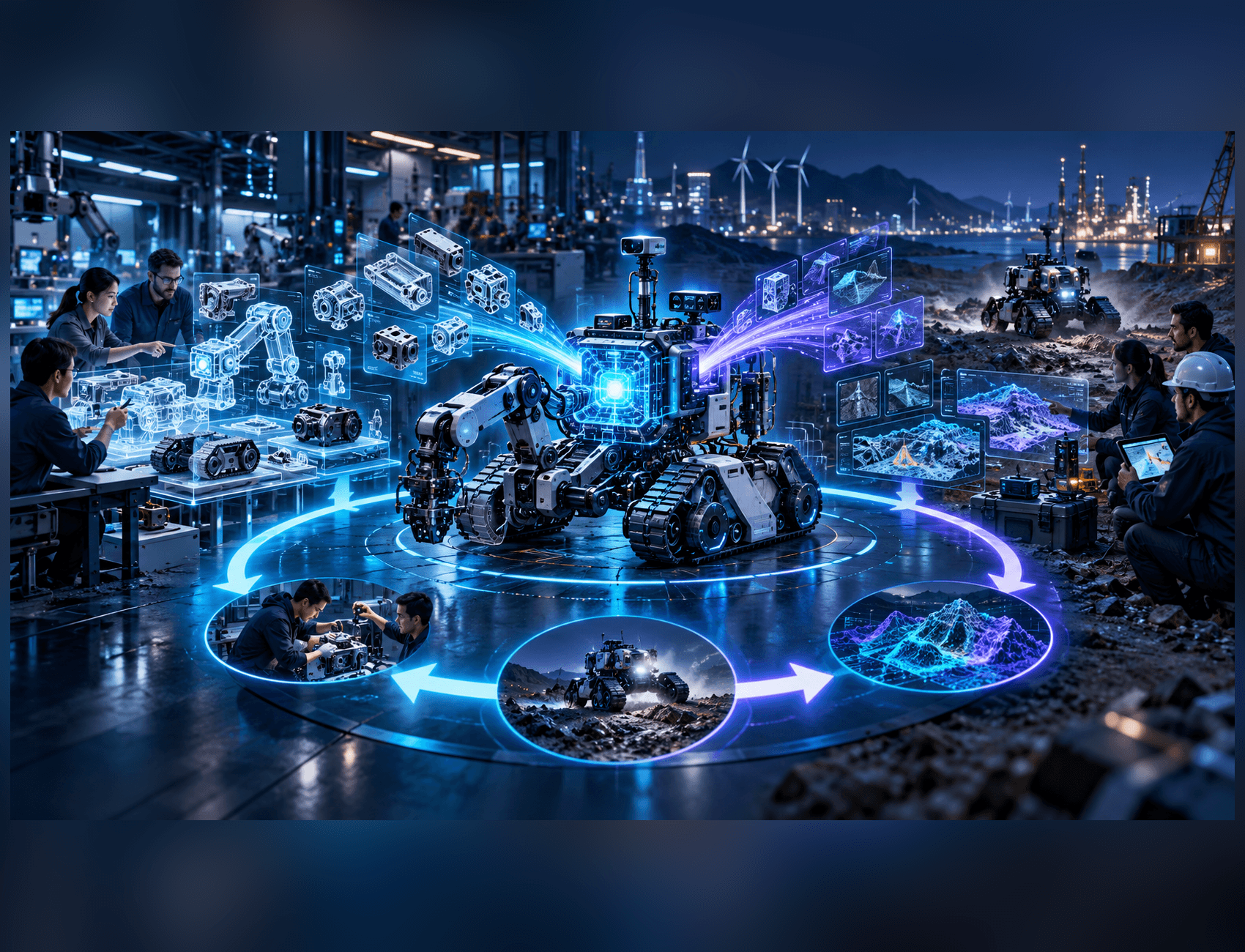
Physical AI will not create durable advantage for Vietnam if local organizations remain buyers, installers, and operators of systems designed elsewhere. The strategic opportunity begins when Vietnamese engineers, factories, research institutions, and international partners jointly define the problem, design the system, test it in real operating conditions, and retain enough knowledge to improve the solution after deployment.
That requires a **Physical AI co-design loop**: a recurring system in which operational problems, engineering choices, field data, safety evidence, and product improvements circulate among users, developers, researchers, and manufacturing partners.
Imported automation can increase output. Co-design builds the capacity to create the next system.
Vietnam's Physical AI opportunity is moving upstream
On October 2, 2026, Vietnam's Ministry of Science and Technology reported that Vietnam and South Korea were expanding cooperation in Physical AI, smart factories, semiconductors, and high-quality human-resource development. A related Vietnam–Korea digital technology forum called for businesses to move from pure outsourcing toward joint research, joint design, joint product development, proof-of-concept deployment, shared intellectual property, and access to third markets.
This is more than diplomatic language. It identifies the real dividing line in technology partnerships.
In a conventional automation project, the buyer specifies a target, a vendor configures equipment, the factory accepts the installation, and the relationship becomes maintenance. Knowledge about the system's architecture, failure modes, model behavior, and future product roadmap remains concentrated with the supplier.
Physical AI changes the economics of that arrangement. A robot, autonomous vehicle, inspection system, or smart production line learns its value from the physical environment in which it operates. Local workflows, materials, climate, safety practices, worker behavior, maintenance capacity, and infrastructure all influence performance. The operating environment is not merely where the product is used. It is part of the product-development process.
What Physical AI co-design means
**Physical AI co-design is the joint development of intelligent machines through repeated cycles of problem definition, system design, field testing, evidence review, and product improvement, with local partners participating in the technical and commercial decisions that shape the solution.**
The word “joint” matters. A local team that only labels data or installs hardware is contributing labor, not necessarily building design authority. Real co-design gives partners meaningful responsibility for requirements, system interfaces, evaluation criteria, safety boundaries, and intellectual-property decisions.
This is especially important because [autonomous AI needs operational boundaries](/blog/autonomous-ai-operational-boundaries). Physical systems act in environments where mistakes can damage equipment, interrupt production, or harm people. The organization closest to the operating context must help define what the system may do, when it must stop, and how humans recover control.
Why imported automation reaches a ceiling
Local adaptation becomes slow and expensive
When operational knowledge and engineering authority are separated, every exception becomes a vendor request. Small workflow changes require external configuration. New product lines create integration delays. Local teams learn to operate the system but not to reshape it.
The result is technical dependence hidden inside a productivity project.
Field data does not become shared learning
Physical AI produces rich evidence: sensor drift, false detections, unusual objects, human workarounds, maintenance events, environmental variation, and safety interventions. If that evidence flows only into a foreign product roadmap, the local organization supplies learning without accumulating it.
Co-design converts field data into shared engineering knowledge. It makes deployment a research asset rather than a terminal implementation step.
Talent development remains shallow
Engineers do not become system architects by attending technology-transfer workshops alone. They develop through responsibility: defining interfaces, diagnosing failures, selecting trade-offs, running controlled tests, and defending design decisions.
This is why [AI partnerships need capability transfer](/blog/vietnam-ai-partnerships-capability-transfer). The strongest indicator of partnership quality is not the number of signed projects. It is whether local teams can solve more difficult problems with less external dependence after each project.
Commercial value stays downstream
Installation, integration, and operations generate revenue, but the highest-value layers often sit in design, core software, proprietary data, validation methods, and product ownership. Without participation in these layers, local firms may scale activity while remaining weak in bargaining power.
Co-design is therefore not only an engineering model. It is a value-capture strategy.
A five-loop architecture for Physical AI co-design
1. Problem ownership loop
Begin with a measurable operating problem, not a technology category. Define the constraint, current loss, affected users, safety context, and economic value of improvement.
The local operator should own this problem definition. An imported solution should not determine which problem deserves attention.
2. Interface ownership loop
Map the interfaces between machines, sensors, models, workers, production systems, maintenance processes, and data infrastructure. Decide which interfaces must remain open, documented, and locally configurable.
Interface ownership creates strategic flexibility. It prevents one successful pilot from becoming a permanent single-vendor dependency.
3. Field-evidence loop
Create a disciplined process for capturing failures, overrides, near misses, operating variation, and maintenance outcomes. Separate anecdotal feedback from structured evidence.
As argued in [scientific AI needs experimental closure](/blog/scientific-ai-experimental-closure), a prediction becomes useful only when it connects to an intervention, an observed result, and a learning update. Physical AI needs the same closure.
4. Engineering-transfer loop
Pair local and international engineers around real design work. Use shared repositories, joint test plans, architecture reviews, failure analysis, and rotating technical leadership. Measure which capabilities become independently executable by the local team.
Training should be embedded in delivery, not added after deployment.
5. Commercialization loop
Agree early on intellectual-property rights, market access, product responsibilities, certification ownership, service revenue, and opportunities in third markets. A system that works in Vietnam may have relevance across Southeast Asia, but only if commercial rights are designed before success creates conflict.
What leaders should measure
Traditional project dashboards track budget, schedule, installation, uptime, and output. A co-design dashboard should also track:
- the share of requirements defined jointly;
- the number of interfaces locally understood and configurable;
- the percentage of field issues resolved without external escalation;
- the number of local engineers able to lead architecture reviews;
- locally owned test data, validation methods, and intellectual property;
- time required to adapt the system to a new product or operating condition;
- revenue or market access created beyond the original deployment.
These measures reveal whether the project is creating only an asset or also a capability.
Conclusion
Vietnam does not need to reject foreign technology to build technological autonomy. It needs partnerships designed so that using technology also strengthens the ability to shape it.
Physical AI makes this urgent because intelligence, hardware, data, safety, and operations cannot be separated cleanly. The system improves through contact with the real environment. The organizations that participate in that learning loop accumulate the most valuable capability.
Imported automation can solve today's problem. A co-design loop creates the engineering authority to solve tomorrow's.
Key Takeaways
- Physical AI performance depends on local operating conditions, making field participation part of product design.
- Co-design requires shared authority over problems, interfaces, evidence, engineering decisions, and commercialization.
- Technology transfer is strongest when local engineers learn through responsibility for real design work.
- Open and documented interfaces reduce dependence and improve adaptability.
- Leaders should measure accumulated capability, not only installation and productivity results.
FAQ
What is Physical AI co-design?
It is the joint development of intelligent machines through repeated cycles of problem definition, system design, field testing, evidence review, and product improvement, with local partners participating in important technical and commercial decisions.
How is co-design different from technology transfer?
Technology transfer may provide documentation, training, or licensed capability after a system is designed. Co-design involves local partners earlier, when requirements, architecture, evaluation, intellectual property, and market strategy are still being shaped.
Why does Physical AI require local participation?
Physical systems interact with local workflows, people, infrastructure, materials, and safety conditions. These factors influence performance and cannot be fully understood through laboratory testing alone.
What should Vietnamese firms negotiate in a Physical AI partnership?
They should clarify access to interfaces and field data, responsibility for testing, engineering participation, intellectual-property rights, adaptation authority, certification duties, and opportunities to commercialize jointly in other markets.