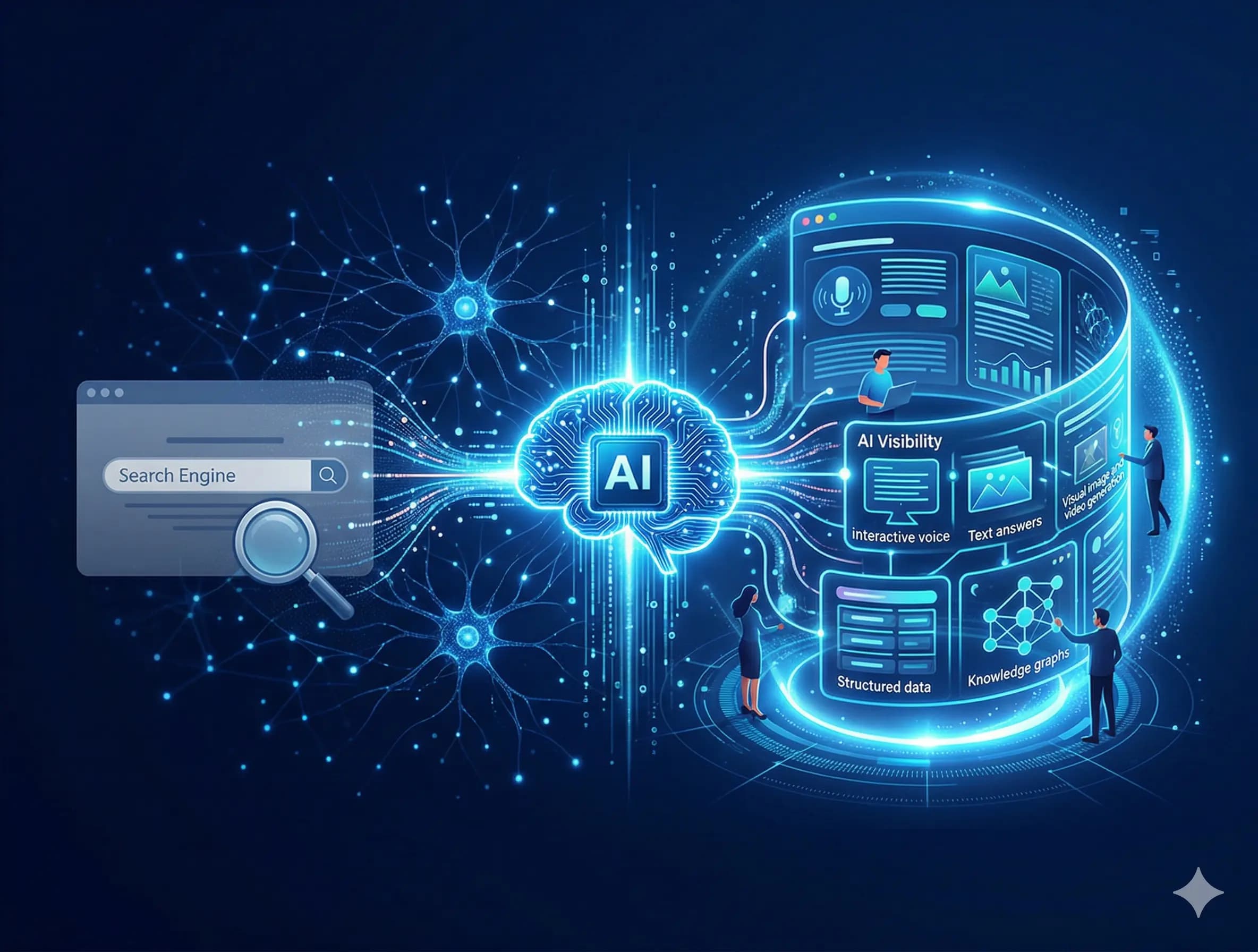
For years, SEO was largely understood as a simple equation:
Rank higher on Google = get more traffic.
That model is no longer enough.
Today, search is being reshaped by AI-powered experiences. Google now surfaces AI features directly inside Search, Microsoft is expanding AI-generated answer experiences across Bing and Copilot, and marketers are increasingly paying attention not only to rankings, but also to whether their content is being understood, selected, and cited by AI systems.
That changes the game.
The future of SEO is no longer just about being indexed by a search engine. It is about being visible inside machine-generated answers. It is about becoming a source that AI can retrieve, trust, summarize, and mention.
In other words, the future of SEO is AI visibility.
Why Traditional SEO Is No Longer the Full Picture
Traditional SEO still matters. Technical health, crawlability, indexing, helpful content, internal linking, metadata, and search intent are not going away. Google still emphasizes people-first, helpful, reliable content, and proper crawling and indexing remain foundational.
But user behavior is evolving.
Instead of clicking through ten blue links, users increasingly expect direct answers, summaries, comparisons, and follow-up responses. Google itself says its AI search experiences are designed for longer, more specific, multi-part questions.
That means the new question is not only:
“Does my page rank?”
It is also:
“Can my content be extracted, interpreted, and referenced by AI?”
A page can technically rank and still fail in this new environment if it is vague, generic, poorly structured, or difficult for AI systems to synthesize.
What AI Visibility Actually Means
AI visibility is the ability of your brand, website, and content to appear inside AI-driven discovery experiences, including:
1. AI-generated search answers
Google’s AI features use indexed web content to help generate responses and surface sources. Microsoft also now tracks when sites are cited in AI-generated answers inside Bing and Copilot experiences.
2. AI citations and mentions
Being on page one is valuable. But in 2026, being quoted or cited by the answer layer can be even more powerful. Bing’s new AI Performance reporting explicitly measures citations in AI-generated answers, which shows how central citation visibility has become.
3. AI-assisted research journeys
Users are no longer searching once. They ask, refine, compare, challenge, and continue the conversation. If your content is not structured to support that journey, it becomes less useful in AI environments. Google has explicitly described AI search as supporting more specific and follow-up questions.
So yes, SEO is still about discoverability.
But now it is also about extractability, clarity, authority, and citation-worthiness.
From Search Ranking to Source Selection
This is the real shift.
In classic SEO, success often meant winning a position.
In AI-era SEO, success increasingly means winning selection.
AI systems do not just list pages. They synthesize information. They look for content that is:
- clear enough to parse,
- specific enough to trust,
- structured enough to extract,
and useful enough to reference.
That is why weak, bloated, generic articles are becoming less defensible.
A page stuffed with keywords may still exist in the index. But if it does not help an AI system form a strong answer, it becomes less strategically valuable.
The new competition is not only for clicks.
It is for inclusion inside the answer itself.
What Google and Bing Are Signaling to Creators
The signals are already clear.
Google’s guidance for AI search experiences continues to emphasize unique, helpful, people-first content, not commodity content made primarily to manipulate rankings. Google also states that appropriate use of AI is allowed, as long as the content is not produced mainly to game search rankings.
At the same time, Google provides documentation on how site owners can manage appearance controls through robots directives and snippet-related settings, which matters because visibility is no longer just about whether a page exists, but also how it can be presented in search experiences.
Microsoft has gone even further by launching an AI Performance view in Bing Webmaster Tools, giving site owners a way to see citation activity in AI-generated answers. That is a strong market signal: brands should now monitor not only impressions and rankings, but also AI references.
This is not a theory anymore.
The platforms themselves are telling us that AI visibility is becoming a measurable layer of search performance.
How to Optimize Content for AI Visibility
Here is where strategy becomes practical.
1. Write for answerability, not just readability
Your content should make it easy for both humans and machines to identify the core answer quickly.
That means:
- concise definitions,
- clear subheadings,
- direct explanations,
- short supporting paragraphs,
and structured takeaways.
If your article hides the answer under long, decorative writing, AI systems may skip it.
2. Prioritize original insight over recycled content
Google repeatedly emphasizes unique, satisfying, non-commodity content. In an AI-first environment, generic content is even weaker because AI can already generate generic summaries on its own.
The content that wins is content with
- original frameworks,
- strong perspective,
- real expertise,
- practical examples,
and a clear point of view.
3. Make your pages technically accessible
None of this works if your site cannot be properly crawled or indexed. Crawl rules, robots directives, and metadata still matter because AI experiences depend on accessible web content and site controls.
4. Structure content like a source
Think beyond “blog post.”
Think:
- definitions,
- step-by-step processes,
- FAQ sections,
- summaries,
- entity clarity,
and semantic relevance.
AI systems prefer content they can break into reliable pieces.
5. Build topical authority, not isolated articles
One strong article helps. A connected body of expertise helps more.
If your site repeatedly publishes useful content around one strategic theme, you increase your chance of being understood as a credible source in that topic cluster.
That matters for both search engines and AI answer systems.
The New SEO Mindset Marketers Need in 2026
The old mindset was
- How do I rank for this keyword?
- The better question now is
- How do I become the most useful source for this topic across search and AI ecosystems?
That is a very different level of thinking.
It pushes marketers to move from:
- keyword obsession to topical authority,
- volume publishing to information quality,
- ranking reports to visibility intelligence,
and content production to source strategy.
This is where SEO starts to overlap with brand authority, knowledge design, and trust architecture.
Because when AI answers users directly, the brands that win are often the ones whose content has already been shaped into something machines can trust and humans can verify.
SEO Is Not Dead. It Is Expanding
Some people like to announce that SEO is dead every time the interface changes.
It is not dead.
It is evolving.
SEO is no longer only about optimizing for a list of search results. It is expanding into a broader visibility discipline where success includes:
- ranking in traditional search,
- appearing in rich search features,
- being cited in AI-generated answers,
and becoming a trusted source in multi-step discovery journeys.
That is why the future of SEO is not “less SEO.”
It is bigger SEO.
More strategic.
More semantic.
More authoritative.
More connected to how knowledge is discovered and delivered.
Final Thought
The brands that will win in the next era are not just the ones that publish more content.
They will be the ones that publish clearer, stronger, more useful, more source-worthy content.
Because in the age of AI, visibility is no longer only about whether a search engine can find you.
It is about whether an AI system can understand you, trust you, and choose you.
And that is exactly why the future of SEO is not just search engines.
It is AI visibility.
FAQ
What is AI visibility in SEO?
AI visibility refers to how easily your content can be discovered, understood, cited, and surfaced within AI-powered search experiences such as Google AI features, Bing AI-generated answers, and other answer engines.
Is traditional SEO still important in 2026?
Yes. Technical SEO, indexing, helpful content, internal linking, and search intent still matter. But they are no longer sufficient on their own. Content must also be structured and useful enough to be selected in AI-generated answers.
Can AI-generated content rank on Google?
Google says using AI or automation is not inherently against its guidelines. The issue is whether content is created to help people or mainly to manipulate rankings.
How can I improve AI visibility for my website?
Focus on people-first content, clear structure, original insights, technically accessible pages, and topic authority. These improve the chances that your content can be crawled, understood, and cited in AI-driven search experiences.


