Artificial intelligence is no longer a future concept in marketing. It is already changing how brands create content, analyze customer behavior, personalize communication, and scale execution.
The real question is no longer whether AI will impact marketing. The real question is whether marketers and businesses are preparing fast enough to stay relevant.
The future of AI in marketing will not belong to those who simply use more tools. It will belong to those who know how to combine AI with strategy, human insight, creativity, and brand thinking.
In this article, we explore the current state of AI in marketing, the biggest trends shaping the future, the risks many businesses ignore, and what you must prepare now.
Why the Future of AI in Marketing Matters
AI is changing marketing at every level.
It affects research, content creation, paid ads, SEO, customer service, reporting, automation, and decision-making. Tasks that once took hours can now be completed in minutes. Small teams can now operate with the speed and output of much larger ones.
But this shift also creates pressure.
When everyone has access to AI tools, speed alone is no longer an advantage. Brands must compete on strategic thinking, originality, trust, and relevance.
That is why the future of AI in marketing is not just about technology. It is about transformation.
Current State: AI Is Already Reshaping Marketing
Today, many marketers already use AI for practical tasks such as:
- content ideation
- article drafting
- ad copy generation
- email personalization
- chatbot support
- SEO optimization
- workflow automation
- reporting and analysis
These are important use cases, but they are still only the beginning.
Most companies are using AI to improve productivity, not yet to redesign their entire marketing system. That creates a major opportunity for businesses that prepare early and think strategically.
Key Trends Shaping the Future of AI in Marketing
AI Will Become Part of Marketing Infrastructure
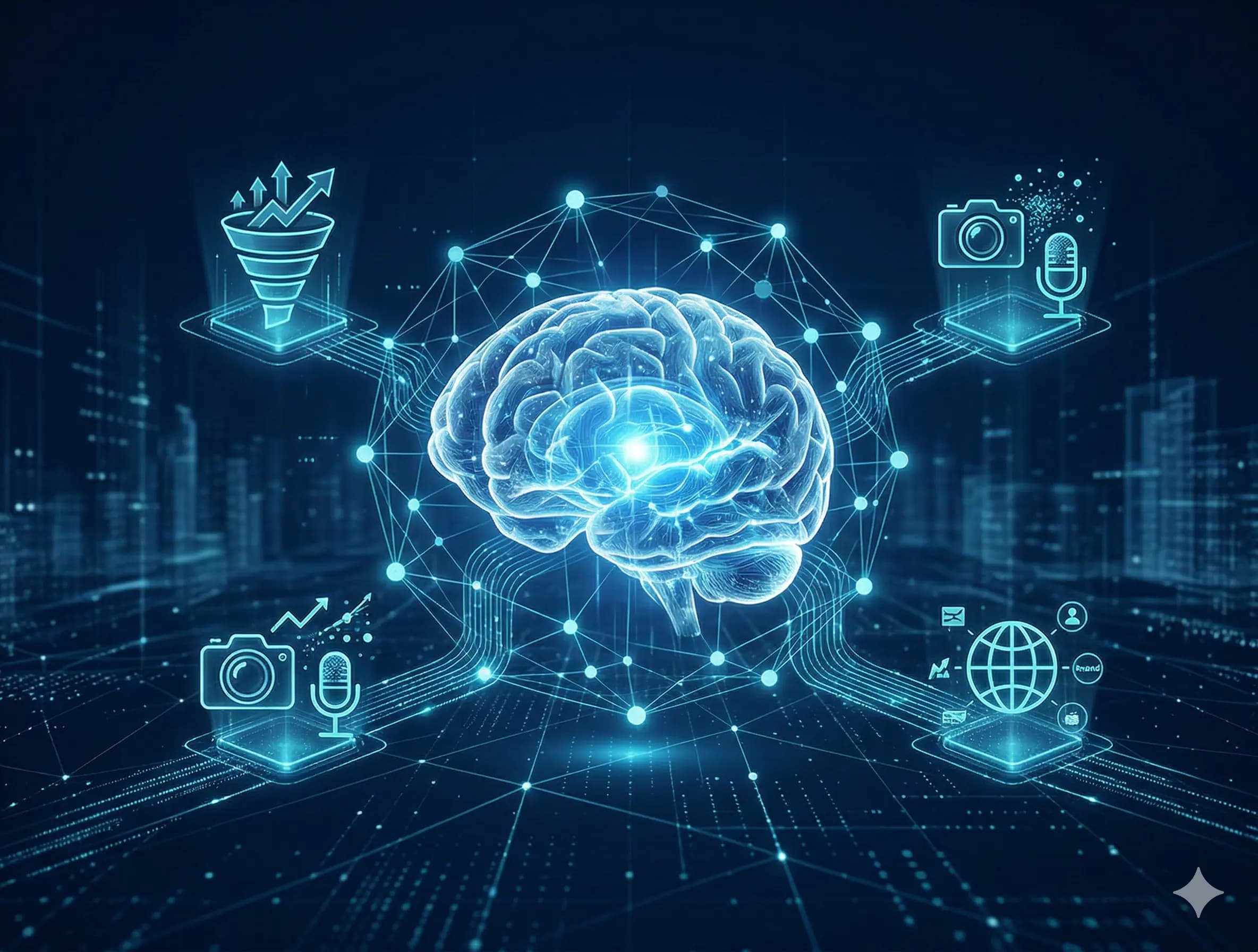
Right now, many teams use AI as a helper. In the future, AI will become part of the actual marketing system.
Instead of using isolated tools for separate tasks, brands will build connected workflows where AI supports research, planning, content production, campaign optimization, and reporting in one process.
The shift will move from using prompts to building systems.
Personalization Will Become More Advanced
AI will make it easier to deliver more relevant messaging to the right audience at the right time.
Instead of broad one-size-fits-all campaigns, brands will increasingly use AI to personalize offers, content, timing, and customer journeys based on data and behavior.
That means generic communication will become less effective over time.
Content Volume Will Rise, but Quality Will Matter More
AI allows brands to publish more content faster. But high volume does not guarantee influence.
As more AI-generated content fills the internet, audiences will pay more attention to content that feels useful, clear, credible, and human. The brands that stand out will not be the loudest. They will be the ones with sharper thinking and stronger positioning.
Search Is Expanding Beyond Traditional SEO
The future of AI in marketing also changes how people discover information.
Users now search through AI tools, answer engines, social platforms, communities, and content ecosystems, not just Google. That means marketers need to think beyond traditional search engine optimization and start preparing for AI visibility and topical authority.
Strategic Thinking Will Become More Valuable
As AI automates more execution, the value of marketers will move toward higher-level thinking.
The future belongs to marketers who can define positioning, understand customer psychology, design systems, interpret data, and make sound strategic decisions.
AI will increase the value of strategic marketers, not replace them.
Opportunities Marketers Should Pay Attention To
Faster Execution
AI reduces the time needed for research, ideation, writing, optimization, and reporting. This helps teams move faster without always expanding headcount.
Better Scalability
Small and medium-sized businesses can now perform at a much higher level with fewer resources. AI gives lean teams greater leverage.
Smarter Decisions
AI helps marketers analyze patterns, summarize data, and identify opportunities faster. This improves campaign planning and performance management.
Better Customer Experience
AI can support faster responses, more relevant recommendations, and smoother communication across the customer journey.
Risks Businesses Must Not Ignore
Over-Automation Can Weaken Brand Identity
If brands rely too heavily on AI without human direction, messaging can become generic and lose emotional depth.
High Output Can Hide Weak Strategy
AI can produce content quickly, but it cannot replace clear positioning and strategic thinking. More activity does not always mean better marketing.
Teams May Become Tool-Dependent
Some marketers learn how to use AI tools without learning how to think critically. That creates dependence without real capability.
Trust and Ethics Will Matter More
As AI use increases, brands must be more careful about accuracy, transparency, privacy, and responsible communication. Trust will become a major competitive advantage.
What You Must Prepare Now
Build AI Literacy Across the Team
Marketers do not need to become engineers, but they do need to understand what AI can do, what it cannot do well, and where it creates real value.
Redesign Workflows, Not Just Individual Tasks
Do not stop at using AI for captions or blog drafts. Look at your full workflow and identify where AI can improve speed, clarity, and efficiency.
Strengthen Brand Positioning
As AI makes content easier to create, brand clarity becomes even more important. Businesses need a clear voice, a strong point of view, and a distinct market position.
Invest in Human Skills
The future of AI in marketing still depends on human strengths such as strategic thinking, creativity, emotional intelligence, leadership, and judgment.
Build a Culture of Experimentation
AI will keep evolving. The smartest businesses will not wait for a perfect system. They will test, learn, refine, and adapt continuously.
Final Thoughts
The future of AI in marketing is already here.
AI will not automatically make a brand more effective. It will amplify whatever is already there. If the strategy is weak, AI will scale weak execution. If the thinking is strong, AI will multiply impact.
That is why preparation matters.
The businesses that win will not be the ones chasing every new tool. They will be the ones building a strong foundation where AI supports strategy, creativity, and long-term brand value.
FAQ
What is the future of AI in marketing?
The future of AI in marketing involves deeper automation, more advanced personalization, stronger data analysis, smarter workflows, and a greater need for strategic thinking. AI will become part of marketing infrastructure rather than just an optional tool.
How is AI changing marketing today?
AI is already changing marketing through content creation, SEO support, ad copy generation, customer service automation, analytics, personalization, and workflow optimization.
Will AI replace marketers?
AI will replace some repetitive tasks, but it will not replace the need for strategy, creativity, customer understanding, and human judgment. Marketers who know how to work with AI will be more valuable.
What should marketers prepare for now?
Marketers should build AI literacy, redesign workflows, strengthen brand strategy, improve human-centered skills, and develop a culture of testing and adaptation.
Why is brand strategy still important in the age of AI?
Because AI can generate content quickly, but it cannot define a brand’s true positioning, emotional resonance, or long-term vision on its own. Strategy is what gives AI direction.
Excerpt
The future of AI in marketing is changing how brands create content, personalize communication, and scale execution. Here is what marketers must prepare now to stay relevant and competitive.