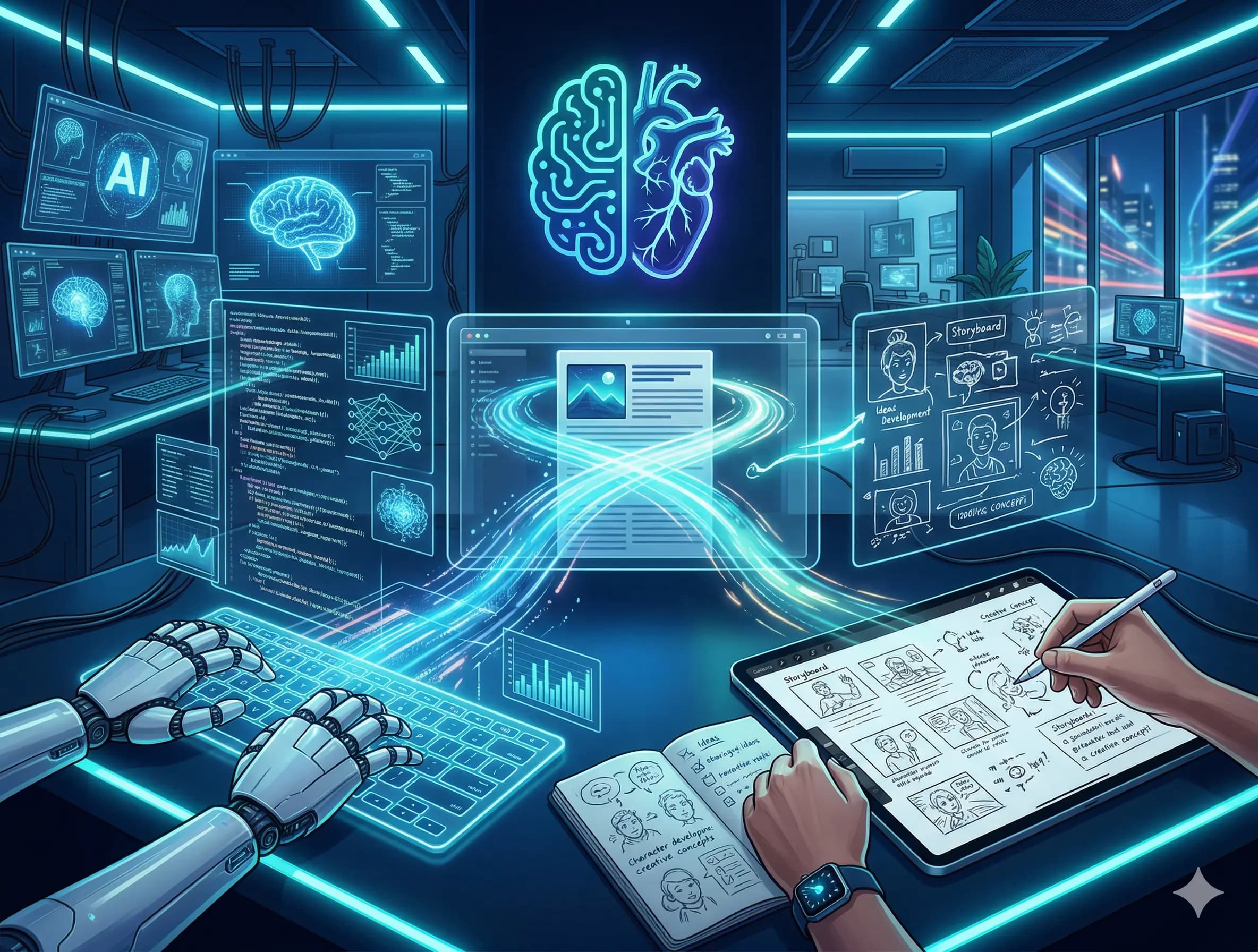
AI vs human content is no longer a theoretical debate in 2026. AI can already generate blog posts, social captions, email sequences, landing page copy, and even full SEO drafts in minutes. But the real question is no longer whether AI can write.
The real question is this: what actually works?
For marketers, founders, educators, and content strategists, this matters more than ever. Because while AI has dramatically increased content production speed, it has also flooded the internet with content that feels repetitive, generic, and forgettable.
That is why the brands that will win in 2026 are not the ones publishing the most. They are the ones that understand how to use AI intelligently while keeping human insight at the center.
The Real Problem Is Not AI. It Is Generic Content
Many people blame AI for the decline in content quality. But AI is not the core problem.
The real issue is that AI has made it easier to mass-produce content without original thought, strategic depth, or a distinctive point of view.
Today, the internet is full of content that is technically correct but emotionally empty. It may be well-structured. It may even be SEO-friendly. But it often lacks lived experience, sharp judgment, and genuine perspective.
That is why the better question is not whether AI content is good or bad.
The better question is whether the content feels useful, credible, memorable, and human enough to earn attention in an oversaturated content environment.
Why AI Content Became So Popular So Fast
AI content became popular because it solves several immediate business problems at once.
Speed and scalability
AI helps teams generate ideas, outlines, first drafts, metadata, and repurposed content much faster than manual workflows. For businesses under pressure to publish consistently, that speed is a major advantage.
Lower creative friction
Many people do not struggle because they lack ideas. They struggle because starting is difficult. AI reduces the blank-page problem and makes content creation feel more accessible.
Better operational efficiency
For SEO teams, educators, consultants, and agencies, AI is extremely useful for repetitive writing tasks such as outlining, summarizing, expanding bullet points, generating FAQs, and creating multiple content variations.
Stronger content systems
AI performs best when it is used inside a clear content system. If a brand already knows its audience, tone of voice, and positioning, AI can become a powerful execution layer.
AI is no longer just a trend. It is now part of modern content infrastructure.
Where AI Content Is Strong
AI has real strengths, especially when the goal is efficiency and scale.
AI is strong at organizing information
AI can quickly turn scattered thoughts into clear outlines, summaries, and draft structures. This makes it valuable for blog planning, research framing, and SEO content mapping.
AI is strong at identifying patterns
Because it is trained on massive language datasets, AI is effective at spotting common search intent, recurring content angles, and semantic relationships between topics.
AI is strong at repurposing content
One long-form article can be transformed into social media posts, email copy, short captions, FAQs, or video hooks with far less manual effort.
AI is strong at first drafts
A first draft does not need to be perfect. It needs to exist. AI is often excellent for creating momentum and giving teams something to refine.
AI is powerful when the goal is to accelerate production. But content is not only about production. It is also about perception, trust, and authority.
Where Human Content Still Wins
This is where human content remains essential.
Humans create meaning, not just text
A human writer or strategist does more than generate sentences. They interpret context, connect ideas through experience, and bring intellectual judgment into the message.
That is why strong human content often feels more alive. It carries a real mind behind it.
Humans bring original perspective
AI is good at remixing what already exists. Humans are better at expressing conviction, insight, lived observation, and strategic nuance.
That is what creates authority.
Humans understand emotional truth
The best content is not always the most optimized. Often, it is the most honest. Human creators can understand vulnerability, irony, cultural context, sensitivity, and emotional tone in ways AI still struggles to reproduce authentically.
Humans build brand soul
A real brand is not just a consistent template. It has values, taste, worldview, and a recognizable voice. That layer still requires human direction.
In 2026, audiences are becoming more sensitive to what feels real and what feels manufactured. That makes human depth even more important.
AI vs Human Content in SEO: What Performs Better?
The answer depends on what kind of performance you care about.
If the goal is publishing speed, AI wins
AI can help marketers create more content, build topic clusters faster, and maintain a consistent publishing calendar.
If the goal is trust and authority, humans still lead
Content that earns backlinks, shares, discussion, and long-term credibility usually needs strong human thinking. Audiences do not just evaluate structure. They evaluate depth and authenticity.
If the goal is long-term brand equity, hybrid wins
The most effective content strategy in 2026 is not fully AI-generated or fully manual. It is AI-assisted and human-shaped.
That means AI supports speed, structure, and optimization, while humans add judgment, originality, tone, and strategic value.
This hybrid model creates content that is both scalable and distinctive.
Why Pure AI Content Often Fails
Many brands are publishing more content than ever but still failing to build meaningful traction.
Here is why.
It sounds polished but not memorable
AI-generated content often looks clean on the surface, but the phrasing can feel predictable. When every article sounds like a refined version of existing internet content, it becomes forgettable.
It lacks sharp positioning
Great content usually takes a stance. Pure AI content often defaults to safe, neutral language unless it is directed very carefully. That makes it strategically weaker.
It misses lived specificity
What makes content feel trustworthy is often specificity: real examples, real tension, real decisions, and real perspective. Pure AI output usually struggles to create this layer convincingly.
It can flatten brand identity
If a team relies too heavily on generic AI drafts without strong editing, the brand voice starts losing character. Over time, the content may become efficient but emotionally empty.
And when content loses character, authority becomes much harder to build.
The Hybrid Content Model Is What Actually Works in 2026
This is the model that works best now.
In 2026, the real opportunity is not AI replacing humans. It is AI amplifying humans.
Step 1: Use AI for speed and structure
Use AI for tasks such as topic ideation, outline creation, metadata support, FAQ drafting, research organization, and content repurposing.
This improves efficiency and reduces creative friction.
Step 2: Use humans for insight and refinement
Use human intelligence for strategic angle, editorial judgment, emotional depth, brand voice, contextual interpretation, and final review.
This is where content becomes authoritative rather than generic.
Step 3: Build editorial standards
AI becomes risky when teams use it without a clear standard. The solution is not avoiding AI. The solution is creating stronger editorial discipline.
Clear content standards should define brand voice, acceptable quality, approval thresholds, and the points where human review is mandatory.
Without standards, AI creates noise. With standards, AI creates leverage.
How Smart Marketers Should Think About AI vs Human Content
The smartest marketers are no longer impressed by content volume alone.
They now ask better questions.
Does this content sound like everyone else?
If it does, it will likely disappear into the noise.
Does this content reflect real strategic thinking?
If not, it may generate temporary traffic but fail to build trust.
Does this content strengthen the brand?
If it does not reinforce a distinct worldview or positioning, it is content without long-term memory value.
Does this content feel human where it matters most?
Speed matters. Efficiency matters. But connection still matters more.
That is why mature marketers are not choosing sides. They are designing better systems.
A Better Way to Think About the Future of Content
Instead of asking whether AI content is better than human content, it is smarter to ask this:
- Which parts of content creation should be automated, and which parts should remain deeply human?
That question leads to a better content strategy.
Because the future of content is not machine or human.
It is machine-assisted human intelligence.
AI can help a brand publish faster. Humans help a brand matter.
And in 2026, being faster is useful. But being credible, memorable, and trusted is what actually works.
Final Thoughts
The debate around AI vs human content often sounds dramatic, but the answer is more practical than ideological.
AI is a powerful tool.
Human intelligence is the differentiator.
Strategy is the bridge between them.
The brands that will lead in 2026 are the ones that stop treating AI like a shortcut and start using it like a system. They will let AI handle repetition, scale, and efficiency while keeping human thought at the center of trust, meaning, and authority.
That is not just a smarter content model.
It is a real competitive advantage.
CTA
Want to build a smarter hybrid content strategy in 2026?
Explore more insights on AI, marketing, and strategic thinking at trananhvu.com.