Vietnam’s first participation in the International Olympiad in Artificial Intelligence produced an impressive result: seven of eight students won medals, including two gold medals.
The achievement deserves recognition. It demonstrates intellectual ability, disciplined preparation, and the emergence of serious AI talent at the school level.
But the strategic value of an elite result depends on what happens after the medals.
If excellence remains concentrated in a small competition system, the country gains recognition. If the knowledge, methods, mentors, and motivation circulate back into schools and communities, the country gains capability.
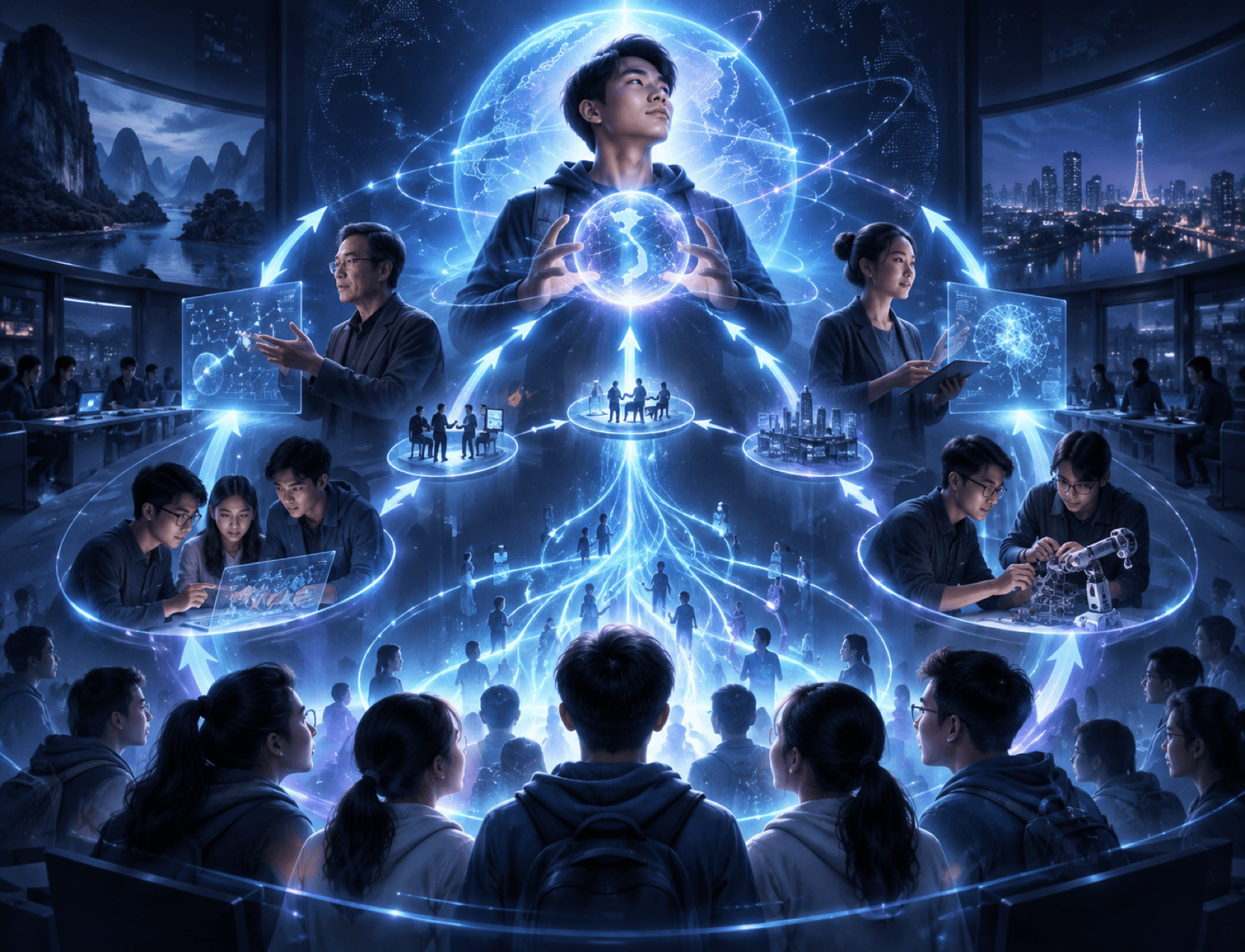
Vietnam’s AI education challenge is therefore not only to produce exceptional students. It is to build a talent flywheel that allows exceptional performance to raise the quality of the wider learning system.
A medal is evidence, not yet infrastructure
According to Vietnam’s Ministry of Education and Training, the [2026 International Olympiad in Artificial Intelligence](https://vqa.moet.gov.vn/vi/news/tin-tuc-su-kien/7-8-hoc-sinh-viet-nam-doat-huy-chuong-trong-lan-dau-tien-tham-du-olympic-tri-tue-nhan-tao-quoc-te-288.html) brought together 108 teams and 471 students in the individual AI-programming competition. Vietnam earned seven medals in its first participation.
This result shows what becomes possible when talented learners receive advanced content, expert mentorship, peer challenge, and a demanding performance standard.
Those conditions are not equally available across the education system.
Many students encounter AI mainly as a consumer tool. They learn to ask for answers, generate content, or speed up homework. Fewer receive structured opportunities to understand data, models, evaluation, uncertainty, experimentation, and responsible system design.
The gap is not simply between students who can code and students who cannot. It is between learners who experience AI as an object of inquiry and learners who experience it only as a convenient interface.
An education strategy must close that gap without pretending every student should become an AI researcher.
The purpose is broad AI agency
National AI capability needs multiple layers of talent.
It needs researchers who can advance models and methods. It needs engineers who can build reliable systems. It needs domain experts who can apply AI in healthcare, manufacturing, agriculture, education, public services, and business. It needs teachers who can guide responsible learning. It also needs citizens who can evaluate AI-mediated claims and decisions.
The goal is not uniform technical depth. It is broad AI agency: the ability to understand what AI is doing, frame appropriate problems, judge evidence, work with systems responsibly, and know when human intervention matters.
Elite competitions occupy one important point in this system. They identify and stretch high-potential learners. Their wider contribution grows when they also generate teaching knowledge, peer networks, and visible pathways for others.
How a talent flywheel works
A flywheel compounds because each cycle strengthens the next. In AI education, five movements should reinforce one another.
1. Identify talent through multiple doors
Competition performance is one signal of potential, but not the only one.
Some students show strength in mathematics or programming. Others excel at scientific inquiry, design, language, ethics, data interpretation, or domain problem-solving. AI is interdisciplinary enough that a narrow selection mechanism can miss valuable forms of ability.
Schools need multiple entry points: clubs, open challenges, project exhibitions, teacher nominations, online modules, community problems, and research experiences.
The system should discover more kinds of talent before it decides which talent matters.
2. Convert expert preparation into teacher knowledge
Olympiad preparation produces valuable instructional assets: problem sets, conceptual sequences, common misconceptions, evaluation methods, and mentoring practices.
Too often, this knowledge stays inside a small team.
A talent flywheel converts elite preparation into teacher development. Coaches can document learning progressions. Competition alumni can support workshops. Advanced exercises can be adapted into classroom-ready modules at different levels.
The purpose is not to turn every class into competition training. It is to transfer the underlying pedagogy of deep problem-solving.
3. Let students become multipliers
High-performing students should not be treated only as recipients of specialized investment. They can become contributors to the ecosystem.
They can mentor younger learners, explain concepts in accessible language, run peer clubs, create Vietnamese learning resources, and demonstrate how to approach difficult problems.
Teaching also strengthens the expert. Explaining a concept exposes gaps, improves communication, and develops leadership.
The flywheel accelerates when talented students help create more talented students.
4. Connect learning to Vietnamese problems
Competitions create clear tasks and evaluation criteria. Real-world AI problems are less tidy.
Students should have opportunities to work with local challenges: agricultural data, language resources, accessibility, environmental monitoring, public information, logistics, small-business operations, or learning support.
These projects teach a deeper lesson. AI quality depends not only on the model, but also on problem framing, data quality, context, stakeholder needs, and responsible deployment.
National talent becomes more valuable when it learns to see domestic problems as worthy of advanced intelligence.
5. Preserve pathways beyond the event
A medal can create motivation, but a pathway creates continuity.
Students need visible next steps: advanced coursework, research mentorship, university connections, internships, scholarships, open-source communities, startup projects, and interdisciplinary programs.
Without continuity, each cohort begins again. With continuity, alumni become mentors, teachers improve, institutions collaborate, and knowledge compounds.
The teacher is the scaling mechanism
Technology can distribute content widely, but teachers scale intellectual standards.
They help students distinguish understanding from fluent output. They create productive difficulty. They observe how a learner reasons, not only whether the final answer is correct. They connect technical work to ethical and social consequences.
For AI education to spread responsibly, teachers need more than tool demonstrations. They need curriculum models, assessment methods, examples of student work, access to mentors, and time to build confidence.
The strongest national program would treat every elite AI achievement as an opportunity to strengthen teacher capacity.
After a competition, the system should ask:
- Which concepts proved most difficult?
- Which teaching methods produced the strongest learning?
- Which resources can be adapted for broader use?
- Which students and coaches can mentor others?
- Which schools or regions need additional access?
- Which pathways will keep participants engaged?
These questions turn a result into reusable infrastructure.
Excellence and inclusion are not opposites
There is sometimes a false choice between investing in elite talent and expanding broad access.
A well-designed flywheel connects the two.
Elite environments can push the frontier, reveal effective learning methods, and create visible role models. Broad access expands the pool from which future excellence emerges. Each strengthens the other.
The real risk is not excellence. It is isolation—when expert knowledge, opportunity, and networks remain disconnected from the wider system.
Vietnam can preserve demanding standards while ensuring that their benefits travel.
A practical design for schools and institutions
An AI talent flywheel can begin with a simple annual cycle:
- **Explore:** give many students low-barrier exposure to AI concepts and real problems.
- **Identify:** use varied projects and challenges to detect interest and potential.
- **Develop:** provide deeper mentorship, technical foundations, and collaborative practice.
- **Perform:** create opportunities for competitions, research, and public demonstration.
- **Diffuse:** turn methods and student experience into teacher resources and peer learning.
- **Continue:** connect participants to the next institution, project, or community.
The final two stages are often the difference between an event and a system.
Conclusion
Vietnam’s 2026 AI Olympiad result is more than a proud moment. It is evidence that high-level capability already exists among young learners.
The next strategic task is to make that capability circulate.
Medals recognize excellence at a point in time. A talent flywheel transforms excellence into mentors, methods, pathways, projects, and wider opportunity.
The future of AI education will not be defined only by how far the strongest students can go. It will also be defined by how much stronger the learning system becomes because they went there.
Key Takeaways
- Vietnam won seven medals in its first participation in the 2026 International Olympiad in Artificial Intelligence.
- Elite achievement becomes national capability when knowledge and opportunity circulate back into the system.
- A talent flywheel connects identification, development, performance, diffusion, and continuity.
- Teachers are the main scaling mechanism for spreading rigorous AI learning.
- Excellence and inclusion reinforce each other when elite knowledge is made reusable.
FAQ
What is an AI talent flywheel?
It is a reinforcing system in which student achievement creates better teaching resources, mentors, pathways, projects, and access, which then produce a larger and stronger future talent pool.
Does every student need to learn AI programming?
No. Students need different levels of depth. Broad AI agency includes problem framing, evidence evaluation, responsible use, and human judgment as well as technical development.
How can Olympiad success benefit ordinary schools?
Coaches and students can translate preparation methods into teacher workshops, adaptable learning modules, peer mentorship, open resources, and local project challenges.