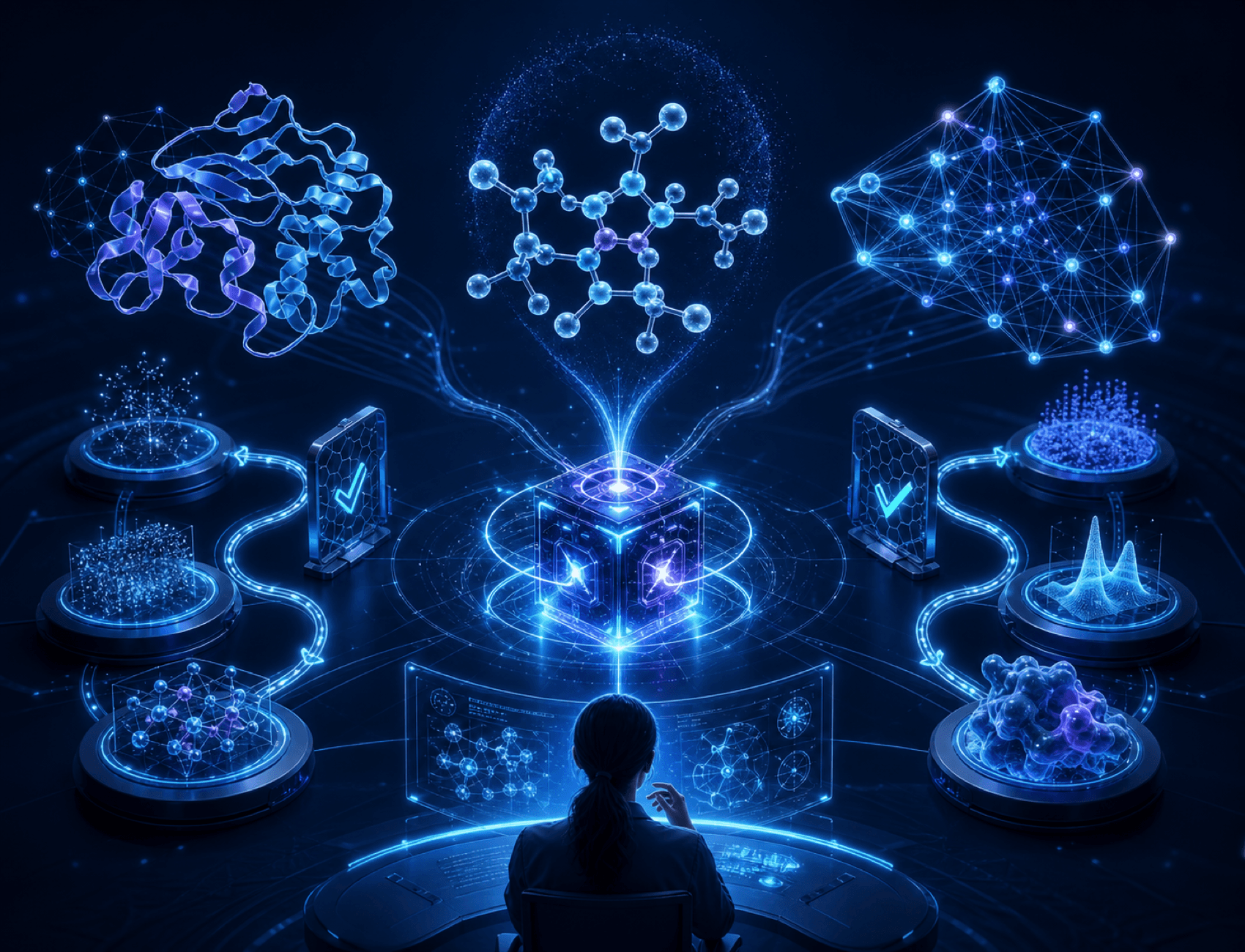
Google's REPLIQA initiative is easy to read as another technology announcement.
That would be too shallow.
The more important signal is not that quantum computing is becoming more powerful, or that AI is entering another technical domain. The deeper signal is that the next stage of AI advantage may not come only from generating text, images, code, or content faster.
It may come from helping humans model systems that were previously too complex to understand well.
In May 2026, Google Quantum AI and Google.org announced REPLIQA, a research program at the intersection of life sciences and quantum AI. The initiative includes a 10 million USD commitment to support research at Harvard University, MIT, UC San Diego, UC Santa Barbara, and the University of Arizona.
The stated ambition is to apply quantum science and AI to life sciences, especially problems involving molecular behavior, protein interactions, enzymes, cellular processes, and biological systems that classical computers struggle to simulate accurately.
This matters because biology is not a simple information problem.
It is a complex systems problem.
And complex systems require more than bigger models. They require better scientific workflows.
The Common Misconception: AI Progress Means Bigger General Models
Most public conversations about AI still revolve around general-purpose models.
Can the model write better?
Can it reason better?
Can it code faster?
Can it understand images, voice, video, documents, and tools?
These capabilities matter. They are already changing work, education, marketing, research, and software development. But they represent only one layer of AI's long-term impact.
The more strategic question is not only whether AI can produce better outputs.
It is whether AI can help humans investigate reality more precisely.
In fields such as biology, chemistry, materials science, and medicine, the hardest problems are not always caused by a lack of language or content. They are caused by a lack of reliable simulation, measurement, and system-level understanding.
A drug does not succeed because a model can describe it beautifully.
It succeeds because scientists can understand how molecules interact, how proteins fold, how enzymes behave, how cells respond, and how uncertainty changes across biological contexts.
That is a different class of problem.
Why Biology Is a Different AI Challenge
Biology is difficult because it operates across many interacting layers.
Molecules interact with proteins. Proteins influence pathways. Pathways shape cellular behavior. Cellular behavior affects tissues, organs, patients, and populations.
Small changes at one layer can create large consequences at another.
This is why biological research is not only a data problem. It is a modeling problem.
Classical computers have helped science enormously, but some molecular interactions are extremely hard to simulate because they are governed by quantum mechanical behavior. When the underlying system follows quantum rules, classical approximation can become costly, incomplete, or too slow for certain research goals.
Quantum computing is interesting here because it is not trying to imitate nature from the outside in the same way classical systems do. At least in principle, it uses quantum properties to model quantum systems more naturally.
AI then adds another layer.
It can help optimize algorithms, identify patterns, guide experiments, interpret outputs, and support decision-making across large research spaces.
The opportunity is not quantum computing alone.
It is the combination of quantum hardware, AI algorithms, scientific expertise, experimental design, and human judgment.
The Real Shift: From Content Generation to Discovery Infrastructure
For many organizations, AI adoption still means productivity.
Write faster. Summarize faster. Design faster. Automate faster.
That is useful, but it is not the deepest form of AI leverage.
The deeper form is discovery infrastructure.
Discovery infrastructure helps humans explore problems they could not previously explore at the same depth, speed, or resolution. It changes the quality of inquiry, not only the speed of execution.
In life sciences, this could mean:
- simulating molecular interactions more accurately;
- exploring drug candidates with better evidence;
- understanding enzyme behavior in more detail;
- designing experiments with stronger feedback loops;
- combining biological knowledge with computational modeling;
- reducing blind trial-and-error in research pipelines.
This does not mean quantum AI will instantly solve medicine.
That would be hype.
The more realistic point is that scientific progress depends on better instruments. Microscopes changed what scientists could see. Sequencing changed what scientists could read. Computational modeling changed what scientists could test before entering the lab.
Quantum AI may become another layer of scientific instrumentation.
Not a replacement for scientists.
A new infrastructure for asking better questions.
Why Workflow Design Matters More Than Technology Announcements
The risk with announcements like REPLIQA is that people reduce them to technological optimism.
Quantum computing plus AI sounds powerful, so the assumption becomes: breakthroughs will automatically follow.
But scientific breakthroughs rarely come from tools alone.
They come from workflows that connect tools to disciplined inquiry.
A mature quantum AI research workflow needs several layers.
First, it needs problem selection. Not every biological question is suitable for quantum methods. Teams must identify where quantum simulation could create meaningful advantage over classical approaches.
Second, it needs data quality and experimental context. A model is only useful when its inputs, assumptions, and constraints are understood.
Third, it needs interdisciplinary translation. Physicists, computer scientists, biologists, chemists, clinicians, and domain experts must align on what the model is actually representing.
Fourth, it needs validation. A computational result must be compared against experimental evidence, not treated as truth because it came from an advanced system.
Fifth, it needs human judgment. Scientists must decide what is plausible, what is useful, what is uncertain, and what should be tested next.
Without these layers, advanced technology can create impressive outputs without reliable understanding.
The Strategic Implication for AI Leaders
REPLIQA points to a larger lesson beyond life sciences.
AI advantage will increasingly belong to organizations that know how to connect intelligence to domain systems.
Generic AI capability is becoming easier to access. Many teams can use the same models, the same interfaces, and the same automation tools.
The real difference will come from how well an organization designs the surrounding system:
- What problem is worth solving?
- What data and context are required?
- What workflow converts model output into better decisions?
- What evidence proves that the system works?
- Where must human expertise remain in control?
- How does learning compound over time?
This is true in healthcare, marketing, education, operations, finance, and leadership.
The model is only one part of the system.
The operating model around the model determines whether AI creates real value.
A Practical Framework: Scientific AI Readiness
Organizations that want to move from AI usage to AI advantage need a readiness framework.
1. Define the system, not only the task
Do not begin with "What can AI generate?"
Begin with "What system are we trying to understand, improve, or decide within?"
In life sciences, that system may be a molecular pathway. In marketing, it may be customer trust. In education, it may be learning transfer. In leadership, it may be decision quality.
The unit of value is the system, not the prompt.
2. Identify where complexity blocks progress
AI is most valuable when it reduces a real bottleneck.
The bottleneck may be simulation, interpretation, evaluation, coordination, or decision latency. If the bottleneck is unclear, AI adoption becomes scattered.
In REPLIQA's case, the bottleneck is the difficulty of modeling complex biological interactions with classical methods alone.
3. Build validation into the workflow
Advanced models can still be wrong.
The more powerful the system, the more important validation becomes. Teams need evidence loops, expert review, experimental checks, and clear standards for what counts as reliable output.
Speed without validation only accelerates error.
4. Keep human judgment explicit
Human experts should not disappear from AI workflows.
They should become more intentional.
Their role is to frame the problem, interpret uncertainty, challenge assumptions, design experiments, and decide what action should follow from the result.
AI can expand the search space.
Humans still carry responsibility for judgment.
Conclusion
Google's REPLIQA initiative is not just a story about quantum computing entering biology.
It is a signal that the next frontier of AI may be less about producing more content and more about building better discovery systems.
This distinction matters.
If organizations think AI is mainly a tool for faster output, they will use it at the surface of work. If they understand AI as infrastructure for modeling complexity, improving decisions, and strengthening expert workflows, they will build deeper advantage.
Quantum AI will not remove the need for scientists, researchers, strategists, or leaders.
It will increase the value of people who can ask better questions, design better systems, and judge results with discipline.
The future of AI is not only bigger models.
It is better workflows for understanding complex reality.
Key Takeaways
- REPLIQA is best understood as a signal about scientific AI infrastructure, not just a quantum computing announcement.
- The next stage of AI advantage may come from modeling complex systems, not only generating faster outputs.
- Biology requires simulation, validation, domain expertise, and human judgment because it is a complex systems problem.
- Quantum AI only creates value when embedded into strong scientific workflows.
- Organizations should focus less on model novelty and more on problem selection, evidence loops, workflow design, and decision quality.
FAQ
What is REPLIQA?
REPLIQA is Google's Research Program at the Intersection of Life Sciences and Quantum AI. It was announced by Google Quantum AI and Google.org in May 2026 with a 10 million USD commitment to support research at five academic institutions.
Why does quantum computing matter for life sciences?
Some biological and molecular processes are difficult for classical computers to simulate precisely because they involve quantum mechanical behavior. Quantum computing may help researchers model certain interactions more naturally, especially when combined with AI and scientific expertise.
Will quantum AI replace scientists?
No. Quantum AI may expand what scientists can simulate and explore, but human judgment remains essential for problem framing, experimental design, validation, interpretation, and ethical decision-making.
What can business leaders learn from REPLIQA?
The lesson is that AI advantage does not come from tools alone. It comes from connecting AI capability to domain knowledge, workflow design, validation, and better decisions.


