Every serious AI user eventually runs into the same invisible wall.
You are inside a capable AI assistant like Claude, GPT, or Gemini. You want it to check your CRM, pull something from your project tracker, review a document, or create a calendar event. The model is smart enough to reason through the task. But it cannot reliably reach the system where the real information lives.
The issue is not intelligence. It is connectivity.
That has become one of the biggest friction points in practical AI adoption. Models are becoming more capable, but the way they connect to tools is still fragmented, brittle, and inconsistent. Each integration often needs its own custom plumbing. Each new tool adds more complexity. The result is an AI ecosystem that is powerful in pieces, but messy in practice.
That is where Model Context Protocol , or MCP , starts to matter.
If AI is moving from novelty to infrastructure, then the market needs a cleaner standard for how models interact with tools, data, and external systems. MCP is one of the clearest attempts to solve that problem at the connector layer.
And if it scales the way many expect, it may change not only how AI tools connect, but how AI-assisted work is designed in the first place.
Why AI Tools Have a Connection Problem
To understand why Model Context Protocol matters, it helps to define the problem precisely.
Today, many AI integrations are still built in a point-to-point way. If one AI system needs access to one tool, someone has to build a specific connector for that relationship. If the same AI needs access to a second tool, that usually requires another separate integration. If another AI system wants to connect to those same tools, the work often starts again.
That creates a fragmented environment.
Each connector may have:
- its own logic
- its own maintenance burden
- its own permission model
- its own schema mapping
- its own failure points
Multiply that across the number of AI platforms, software tools, internal systems, and use cases in modern work, and the ecosystem becomes difficult to scale.
This is the real problem MCP is trying to solve.
What Model Context Protocol Actually Means
At a practical level, Model Context Protocol is an open standard designed to make it easier for AI systems to connect to external tools and context in a consistent way.
That includes the ability to:
- read from external sources
- access structured or unstructured data
- interact with tools
- trigger actions
- preserve useful context across environments
The phrase sounds technical, but the underlying idea is simple.
Instead of building every AI-to-tool connection as a one-off engineering project, Model Context Protocol creates a standard way for those connections to happen.
That matters because standardization reduces fragmentation.
And in infrastructure, reduced fragmentation often creates the conditions for scale.
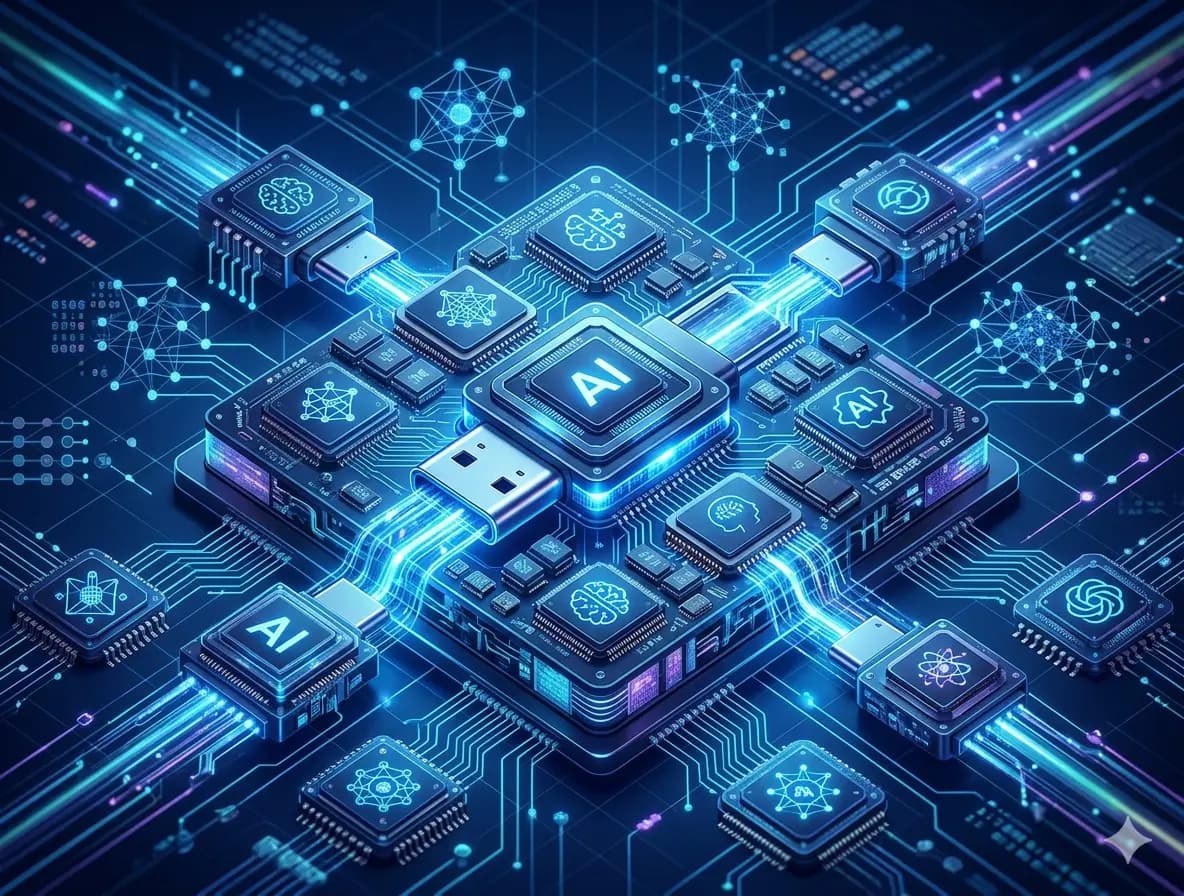
Why MCP Is Being Compared to USB-C
The comparison to USB-C is not about technical similarity. It is about structural function.
Before USB became a standard, hardware connections were far more fragmented. Different devices used different ports, different cables, and different connection logic. The user experience was messy because the underlying interface was not standardized.
USB reduced that friction by creating a more universal connector layer.
The same logic helps explain MCP.
The current AI ecosystem still relies on too many bespoke integrations between models and tools. If Model Context Protocol becomes widely adopted, it could reduce that complexity by giving both sides a shared way to connect.
That is why MCP may become the USB-C of AI tools .
Not because every tool becomes identical. Not because all AI systems become the same. But because the connector layer becomes cleaner, more portable, and more interoperable.
That is the real power of the analogy.
What MCP Does in Practice
The best way to understand Model Context Protocol is to look at what it allows AI systems to do more reliably.
An MCP-compatible setup can help an AI assistant:
- pull information from tools like documents, project trackers, or databases
- interact with software systems without requiring custom logic every time
- maintain better awareness of the working context across tools
- reduce the manual copying and pasting that still defines too much AI use today
These capabilities are not entirely new. What is new is the idea of making them work through a common protocol rather than isolated integrations.
That is a major shift.
Because when the connector becomes standardized, the AI becomes more operationally useful.
Why This Matters for Non-Technical Users
You do not need to be an engineer to care about Model Context Protocol .
In fact, its importance becomes clearer when viewed from the user side.
An AI assistant that only works with information you manually paste into it is helpful, but limited. It can advise on work. It cannot fully operate within work.
An AI assistant that can access your real project context, pull data from your actual tools, and take action inside connected systems is fundamentally different. It can help execute, not just generate.
That is the gap MCP is trying to close.
As more tools expose MCP-compatible interfaces, the assistant becomes less like a detached chatbot and more like a usable layer within the actual workflow.
That is a much more important leap than many people realize.
MCP as Practical Interoperability
A lot of infrastructure language sounds abstract until it affects a real working day.
So consider a common knowledge-work scenario: preparing for a client meeting.
Without strong connectivity, the process often looks like this:
- open the CRM manually
- find recent account notes
- check the project management system
- search email threads
- scan documents
- mentally combine the pieces before the meeting
That is familiar, but inefficient.
With an AI assistant operating through a stronger connection layer, the workflow changes. You can ask for a summary of the account, open items, recent interactions, unresolved issues, and immediate priorities. The assistant pulls from multiple systems, synthesizes what matters, and returns a useful briefing.
The value is not just speed.
The value is that information from multiple tools becomes easier to operationalize inside one coherent interaction.
That is what practical interoperability looks like.
Why the Standard Matters More Than Any Single Integration
This is the deeper strategic point.
A single integration can be useful. But a standard changes the whole ecosystem.
That is because standards create network effects.
The more tools that support Model Context Protocol , the more useful MCP-compatible AI systems become. And the more useful those AI systems become, the more incentive software companies have to support the protocol.
This dynamic matters far more than any one feature announcement.
A custom integration solves one problem. A standard solves a category of problems.
That is why MCP deserves attention at the infrastructure level. If it reaches broad adoption, its value will come not from one impressive use case, but from making many use cases easier to build, use, and scale.
What This Means for AI Product Design
If Model Context Protocol continues to gain traction, it could influence how AI products are designed.
Today, many product teams still compete around:
- model quality
- user interface
- feature lists
- speed of generation
Those things still matter. But as the market matures, connectivity may become just as important.
Teams will increasingly need to ask:
- How easily can this AI connect to the rest of a user’s software environment?
- How portable is the connector layer?
- How much integration friction are we removing?
- How quickly can this tool become useful in a real workflow?
That changes the center of gravity.
Future AI advantage may not come only from intelligence. It may come from how well intelligence is connected.
And that is why Model Context Protocol matters strategically, not just technically.
Why Businesses Should Pay Attention Now
For businesses adopting AI, the bottleneck is often not the model itself.
It is the mess around implementation.
Companies may already know what AI can theoretically do. What slows them down is disconnected systems, inconsistent access to data, fragile integrations, and too much manual setup between tools.
That is where Model Context Protocol becomes important.
It points toward a future where AI can be integrated more cleanly across:
- internal knowledge systems
- customer platforms
- project environments
- reporting workflows
- operational tools
For companies trying to move from experimentation to scaled adoption, that matters enormously.
Because the real business challenge is not just AI capability. It is AI usability inside live systems.
Why MCP May Matter More Than It First Appears
At first glance, Model Context Protocol can sound like just another technical term in a crowded AI landscape.
That would be a mistake.
Its significance comes from what it represents: a move from isolated AI capability to connected AI capability.
The next phase of AI will not be defined only by smarter models. It will be defined by better systems around those models:
- better context access
- better permissions
- better tool interoperability
- better infrastructure standards
- better integration into real work
That is why MCP may matter more than it first appears.
It addresses one of the quietest but most important constraints in applied AI: the connector layer.
And in infrastructure, the quiet layers often become the decisive ones.
Final Thought: The Future of AI Depends on Better Connectors
Much of the public conversation about AI still focuses on outputs.
Better writing. Better summaries. Better search. Better coding. Better assistants.
But underneath that visible layer, another race is taking shape.
It is the race to define the infrastructure that makes AI genuinely usable across environments.
That is where Model Context Protocol becomes meaningful.
If it succeeds, MCP may become the USB-C of AI tools because it helps reduce connection chaos and creates a more universal way for AI systems to reach the context and tools they need.
That would not make MCP flashy.
It would make it foundational.
And foundational infrastructure is often what changes an ecosystem the most.


