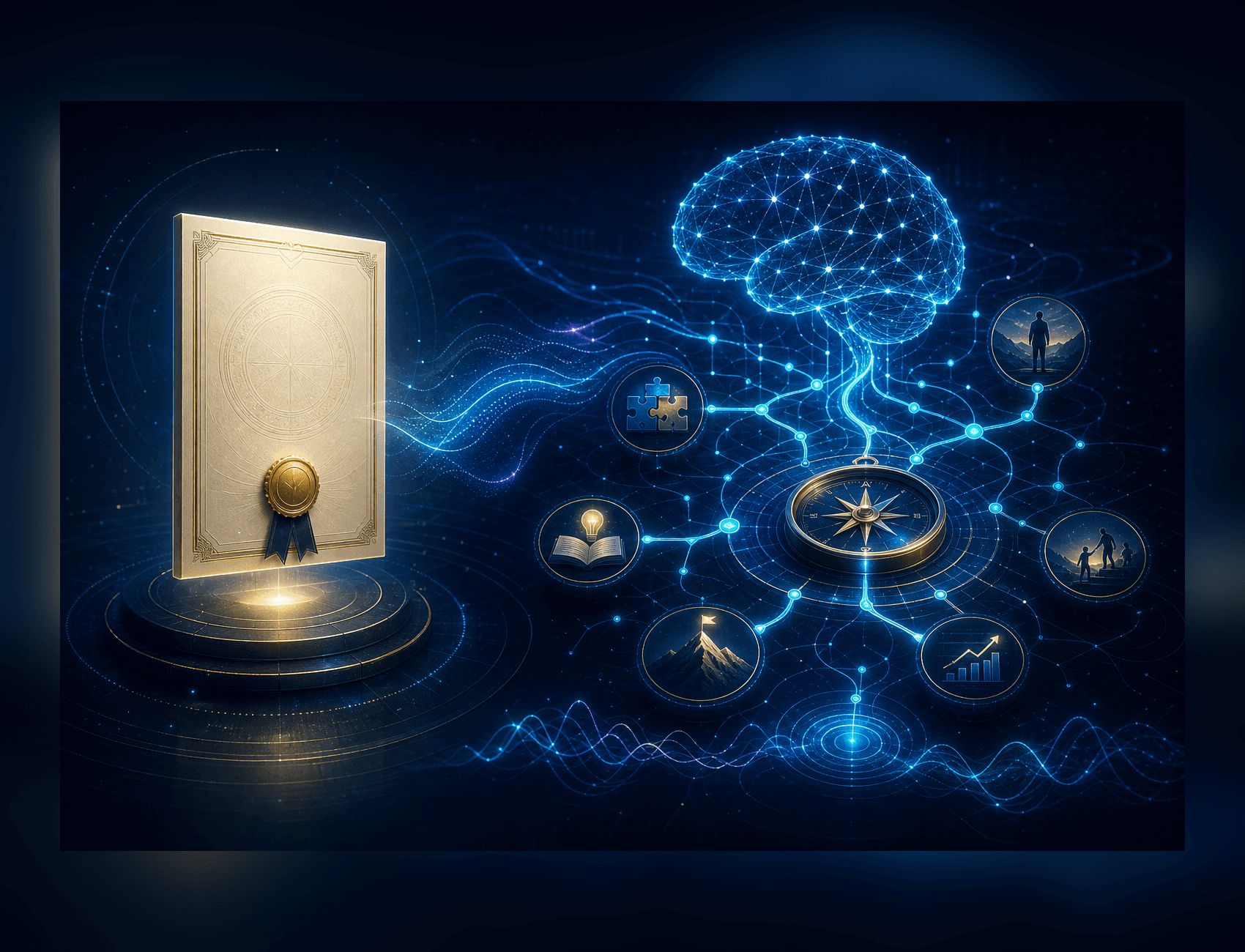
A degree can open doors.
It can show that a person has completed a formal learning path, passed academic requirements, followed institutional standards, and invested time in a field of study.
That matters.
But a higher degree does not automatically prove that someone is truly competent.
This is an uncomfortable but necessary distinction in education today. Many societies still treat degrees as the strongest signal of intelligence, capability, and authority. The more advanced the degree, the more people assume the person must be better, wiser, more capable, or more qualified to lead.
Sometimes that is true.
But not always.
A degree is a credential. Competence is a demonstrated ability to think, judge, solve, create, adapt, and produce value in real conditions.
The two can overlap, but they are not the same thing.
This distinction matters because education should not only produce people who can collect qualifications. It should develop people who can understand reality, make sound judgments, and apply knowledge responsibly.
The Problem Is Not Degrees. It Is Degree Worship
The problem is not that degrees are useless.
Degrees have value. They organize learning, create standards, certify academic progress, and help institutions identify minimum levels of knowledge. In many fields, formal education is essential. Medicine, law, engineering, science, education, and research all require serious training and disciplined study.
The real problem is degree worship.
Degree worship happens when society treats a credential as a complete substitute for competence.
It assumes that because someone has a high degree, they must automatically think better.
It assumes that because someone studied longer, they must automatically understand deeper.
It assumes that because someone has academic status, their judgment must be stronger.
This is risky.
A person can have a degree but still lack practical judgment.
A person can understand theory but fail to apply it in real contexts.
A person can pass exams but avoid independent thinking.
A person can speak with academic language but still lack insight.
A person can hold authority without having intellectual humility.
This does not mean credentials should be dismissed. It means they should be interpreted carefully.
A degree should be treated as one signal, not the whole evidence.
Academic Achievement and Real Capability Are Different
Academic achievement often measures whether a person can perform within an educational system.
Can they study the required materials?
Can they write assignments?
Can they pass examinations?
Can they follow research formats?
Can they complete the requirements of a program?
These abilities are important.
But real capability asks deeper questions.
Can this person frame a problem clearly?
Can they distinguish surface symptoms from root causes?
Can they apply knowledge outside the classroom?
Can they make decisions with incomplete information?
Can they learn when reality contradicts theory?
Can they explain complex ideas simply?
Can they create useful outcomes for others?
Can they stay intellectually honest when they do not know?
These are not always measured well by degrees.
A formal education system can reward compliance, memorization, and correct formatting more than original thinking. It can train people to answer questions that are already defined, but not always to define better questions.
This is where the gap appears.
A person may be academically successful but practically weak.
Another person may not have the highest degree but may possess strong judgment, deep experience, sharp pattern recognition, and real problem-solving ability.
Education should be mature enough to recognize both realities.
Why Credentials Became So Powerful
Credentials became powerful because society needed shortcuts.
Employers, institutions, parents, and communities cannot deeply evaluate everyone’s real competence all the time. A degree provides a simple signal. It says this person has passed through a recognized system.
That signal is useful.
But shortcuts become dangerous when they replace thinking.
If organizations rely too heavily on credentials, they may overlook capable people who do not fit traditional paths. They may also overtrust people whose credentials look strong but whose real judgment is weak.
This creates two problems.
First, talented people without elite credentials may be underestimated.
Second, credentialed people may be overestimated.
Both are bad for society.
The first wastes human potential.
The second creates false authority.
In a fast-changing world, this matters even more. Many important skills today evolve faster than formal education systems can update. AI, digital strategy, entrepreneurship, content systems, product thinking, creative technology, and applied business intelligence often develop through practice, experimentation, and continuous learning.
A degree may show past learning.
But competence must keep proving itself in the present.
The AI Era Makes This Distinction More Important
AI is changing the meaning of knowledge work.
When information becomes easier to access, the value of education shifts. It is no longer enough to know more facts or hold more certificates. The stronger advantage is knowing how to think, evaluate, synthesize, question, apply, and make responsible decisions.
This makes the difference between credential and competence even more important.
AI can help people write, summarize, analyze, code, design, research, and produce outputs faster. But it also exposes shallow thinking.
A person with weak judgment may use AI to create polished but empty work.
A person with strong judgment can use AI to deepen research, test assumptions, improve reasoning, and accelerate meaningful output.
The difference is not the tool.
The difference is the thinker behind the tool.
In this environment, education should not ask only: What degree does this person have?
It should ask:
How does this person think with powerful tools?
How do they verify information?
How do they handle uncertainty?
How do they connect theory to reality?
How do they create value from knowledge?
How do they avoid pretending to understand what they do not understand?
These questions are more important than ever.
What Real Competence Looks Like
Real competence is not loud.
It is not only confidence, vocabulary, title, or academic status.
Real competence shows up in the quality of thinking and the quality of outcomes.
1. The ability to understand problems deeply
Competent people do not rush to solutions before understanding the problem.
They ask better questions. They examine context. They separate symptoms from causes. They know that a visible problem is often only the surface of a deeper system.
This matters in every field.
In education, a weak thinker may say students are lazy. A stronger thinker may ask whether the learning design, assessment method, motivation structure, or classroom culture is broken.
In business, a weak thinker may say sales are low. A stronger thinker may examine positioning, customer trust, offer design, pricing, distribution, and market timing.
Competence begins with problem framing.
2. The ability to apply knowledge in reality
Knowing theory is not the same as applying theory.
A competent person can translate concepts into decisions, systems, processes, and outcomes. They do not only repeat frameworks. They know when a framework fits, when it does not, and how to adapt it to context.
This is where many educated people struggle.
They know the language of a field, but not the behavior of reality.
Real competence lives in the gap between theory and practice.
3. The ability to exercise judgment
Judgment is the ability to choose wisely when there is no perfect answer.
It requires experience, ethics, context, pattern recognition, critical thinking, and humility.
Degrees can support judgment, but they cannot guarantee it.
A person may know many theories and still make poor decisions because they cannot evaluate trade-offs, risks, timing, human behavior, or consequences.
In leadership, education, business, and strategy, judgment often matters more than information.
4. The ability to keep learning
A degree marks the completion of a program.
Competence requires continuous learning.
The world changes. Industries change. Technology changes. Human needs change. A person who stops learning after receiving a degree slowly becomes outdated.
This is why intellectual humility is a sign of real competence.
Competent people do not hide behind credentials. They continue to update their thinking.
They can say, “I need to learn more.”
They can revise their views.
They can admit when reality has changed.
That humility is not weakness. It is intellectual strength.
What Education Should Measure Better
If education wants to prepare people for the future, it must measure more than academic completion.
It should still value knowledge, discipline, and formal study. But it also needs better ways to evaluate deeper capability.
Education should pay more attention to:
- problem framing
- reasoning quality
- critical thinking
- application of knowledge
- ethical judgment
- communication clarity
- ability to learn independently
- ability to work with uncertainty
- ability to use AI responsibly
- ability to create meaningful outcomes
This does not mean every course must become practical in a narrow vocational sense.
Deep academic learning still matters.
But the purpose of education should not be only to produce people who can pass academic checkpoints. It should develop people who can think and act intelligently in the world.
That is a higher standard.
How Organizations Should Evaluate Talent
Organizations also need to rethink how they evaluate people.
Degrees can be part of the evaluation, but they should not be the only filter.
A stronger evaluation should combine credentials with evidence of real competence.
That evidence may include:
- actual work quality
- portfolio or projects
- problem-solving process
- strategic thinking
- communication ability
- references from real collaboration
- case-based assessment
- ability to learn fast
- ethical and professional judgment
- maturity under pressure
This is especially important for roles that require creativity, leadership, strategy, innovation, entrepreneurship, and applied AI capability.
In these fields, the best person is not always the one with the most impressive credential.
The best person is the one who can create the most meaningful value with clarity, responsibility, and learning ability.
The Deeper Purpose of Education
The deeper purpose of education is not only certification.
It is formation.
Education should shape how a person thinks, questions, listens, judges, communicates, and contributes. It should develop intellectual maturity, not only academic achievement.
A good education should make people more capable of facing complexity.
It should help them become more honest with knowledge.
It should train them to avoid shallow certainty.
It should make them better at learning from reality.
If education only produces degrees without competence, it becomes a status system.
If education produces competence, judgment, and humility, it becomes a social force.
That is the difference.
Final Thought
A higher degree deserves respect, but it should not create automatic worship.
It is an achievement, not a complete proof of capability.
Real competence must be demonstrated through thinking, judgment, application, learning, and contribution.
The future of education should not ask only how many degrees a person can collect.
It should ask what kind of thinker the person becomes.
Because in a world shaped by AI, complexity, and continuous change, the most valuable people will not simply be those with the most credentials.
They will be those who can keep learning, think clearly, act responsibly, and create real value from what they know.
Key Takeaways
- A higher degree is a credential, not automatic proof of real competence.
- Degree worship becomes dangerous when society treats academic status as a substitute for judgment.
- Real competence includes problem framing, application, judgment, continuous learning, and meaningful contribution.
- The AI era makes critical thinking and responsible use of knowledge more important than credential signals alone.
- Education should develop intellectual maturity, not only academic completion.
FAQ
Does a higher degree still matter?
Yes. A higher degree can show discipline, formal study, and academic achievement. The point is not that degrees are useless, but that they should not be treated as complete proof of competence.
What is the difference between a degree and competence?
A degree is a formal credential granted by an institution. Competence is the demonstrated ability to think, judge, apply knowledge, solve problems, and create value in real situations.
Why is this issue important in the AI era?
AI makes information and polished output easier to produce. This means the real advantage shifts toward judgment, critical thinking, verification, context, and the ability to use knowledge responsibly.
How should education change?
Education should continue teaching knowledge, but it should also evaluate reasoning quality, problem framing, application, ethical judgment, independent learning, and the ability to work with uncertainty.


