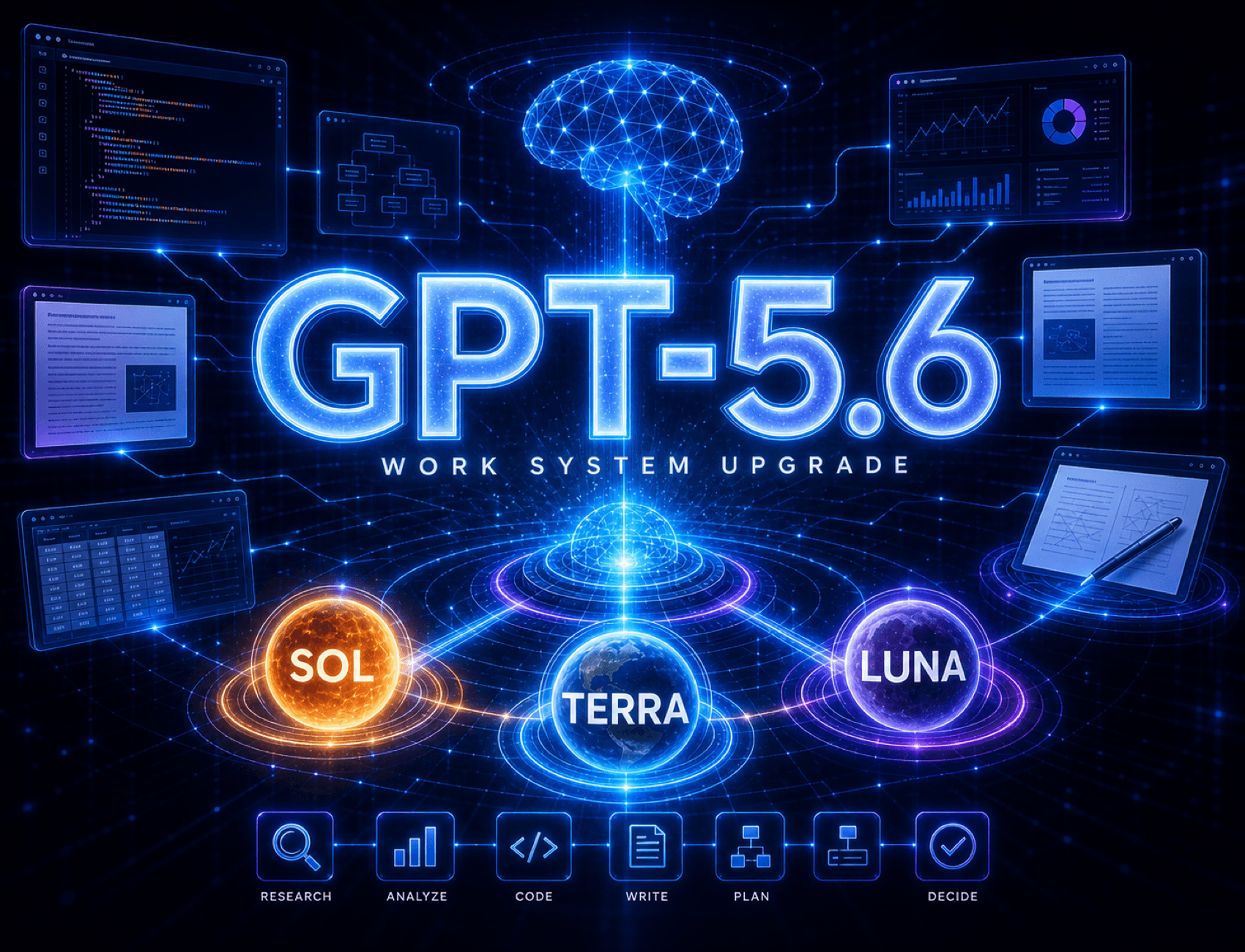
OpenAI has introduced GPT-5.6, and the most important way to understand it is not as “a newer ChatGPT.”
That framing is too small.
For most users, the real shift is this: AI is moving from a response tool toward a work system. The question is no longer only whether ChatGPT can answer better. The deeper question is whether AI can help people navigate complex work with more context, more reasoning, better tool use, and clearer output.
GPT-5.6 should be understood through that lens.
According to OpenAI, GPT-5.6 is available across ChatGPT, Codex, and the OpenAI API, with a gradual rollout. The model family includes Sol, Terra, and Luna. Sol is positioned as the flagship model, Terra as a capable lower-cost option, and Luna as the fastest and most cost-efficient option.
For everyday ChatGPT users, the practical message is simple: GPT-5.6 is not meant to replace every fast interaction. OpenAI says GPT-5.5 Instant remains the default for quick everyday responses, while GPT-5.6 Sol powers more advanced reasoning options for eligible paid plans.
This distinction matters because it shows where AI products are going.
The future is not one model for every task. The future is a system of capabilities matched to the complexity, cost, speed, and risk of the work.
The common misconception: newer model means better answers
Whenever a new model is released, most people ask the same question:
Is it smarter?
That question is understandable, but incomplete.
For users, “smarter” only matters when it changes what they can actually do. A model upgrade is meaningful when it helps people complete more complex tasks, reduce repeated prompting, handle longer workflows, produce better artifacts, or make fewer reasoning mistakes in important work.
OpenAI’s positioning around GPT-5.6 points in this direction. The company describes GPT-5.6 Sol as designed for complex work across coding, knowledge work, research, cybersecurity, science, computer use, and design. It also emphasizes stronger performance in professional workflows, tool use, document creation, spreadsheets, browsing, and computer-use tasks.
That means users should not evaluate GPT-5.6 only by asking whether it can write a nicer paragraph.
They should ask whether it can support a more complete work process.
GPT-5.6 signals a shift from chat to work
The name ChatGPT can make people think the product is mainly about conversation.
But the direction is broader than chat.
OpenAI is also positioning ChatGPT Work as a way for teams to gather context, plan work, take action across tools, files, and desktop apps, and produce polished documents, spreadsheets, and presentations. GPT-5.6 is presented as the model family powering that professional work layer.
This is strategically important.
In the first stage of AI adoption, users asked AI to answer questions or generate content.
In the next stage, users will ask AI to help complete workflows:
- research a market
- compare options
- draft and revise a strategy
- inspect files
- build a working prototype
- prepare a report
- create a presentation
- analyze business data
- coordinate tools
- turn scattered context into usable output
The value is no longer only in the answer.
The value is in the workflow.
What users should understand about GPT-5.6
GPT-5.6 is best explained to users through four practical ideas.
1. It is designed for harder work, not just faster replies
GPT-5.5 Instant remains the default for fast everyday responses in ChatGPT. That is an important signal. Not every task needs deeper reasoning.
If someone asks for a simple explanation, a short email, or a quick summary, speed may matter more than advanced reasoning.
But when the task becomes complex, the value changes.
Complex work often requires multiple steps, trade-off analysis, tool use, context handling, and revision. GPT-5.6 is positioned for that layer of work. Users should therefore learn to choose the right mode for the right task instead of assuming the newest model should be used for everything.
The practical rule is:
Use fast models for simple tasks. Use deeper reasoning models for important work.
2. It introduces a clearer capability tier system
The GPT-5.6 family has three tiers: Sol, Terra, and Luna.
This is useful because AI work is not uniform.
Some tasks need maximum capability. Some need a balance of cost and quality. Some need speed and affordability. A business user preparing a board-level strategy report does not have the same requirement as someone drafting a quick internal note.
The stronger the AI ecosystem becomes, the more users will need model selection literacy.
The question will not be “Which AI is best?”
The better question will be “Which level of capability is appropriate for this task?”
That is a more mature way to use AI.
3. It makes reasoning effort more visible
OpenAI’s ChatGPT guidance explains that GPT-5.6 Sol powers Medium, High, and Extra High reasoning options on eligible plans, while GPT-5.6 Sol Pro is used for the most difficult tasks and longer-running workflows where available.
This matters because users often misunderstand AI reasoning.
Better reasoning usually requires more time, more compute, and more deliberate processing. In real work, that trade-off is normal. A quick answer is not always a better answer. A slower analysis is not always necessary.
Users need to learn when to ask AI to think harder.
Good use cases include:
- strategic planning
- code review
- research synthesis
- complex document analysis
- financial or operational modeling
- product architecture
- high-stakes decision support
- multi-step problem solving
Weak use cases include simple rewriting, quick definitions, short brainstorming, and low-risk everyday questions.
The user skill is not only prompting.
The user skill is deciding how much intelligence a task deserves.
4. It raises the standard for human judgment
More capable AI does not remove the need for human judgment.
It raises the standard for it.
As AI becomes better at reasoning, browsing, coding, designing, and generating professional artifacts, the user’s role shifts. The user must define the problem, provide context, set evaluation criteria, review outputs, and decide what should be trusted.
This is especially important because GPT-5.6 is also stronger in sensitive domains such as cybersecurity and biology. OpenAI’s system card says the model family represents a meaningful step up in cybersecurity capability and that safeguards were designed around those risks.
For users, the implication is clear:
Powerful AI should be used with clearer intent, stronger review, and better boundaries.
The more capable the model becomes, the more important the operating system around the model becomes.
How users can start using GPT-5.6 well
The best way to use GPT-5.6 is not to ask random questions and compare the answer with older models.
A better approach is to bring it real work.
Users can start with this simple framework.
Step 1: Choose a complex task
Do not test GPT-5.6 only with trivia or short prompts.
Choose a task with context, constraints, and a real output:
- “Analyze this customer feedback and identify the top product risks.”
- “Turn these meeting notes into an action plan with owners and deadlines.”
- “Review this marketing strategy and find weak assumptions.”
- “Compare these three business options and recommend a decision.”
- “Read this document and create an executive summary with next steps.”
Step 2: Give context and criteria
The model can reason better when the task is framed well.
Tell it:
- the goal
- the audience
- the constraints
- the output format
- the quality standard
- the trade-offs that matter
Better context produces better work.
Step 3: Ask for a structured process
For important work, ask the model to show its approach at a useful level.
For example:
“Before giving the final answer, identify the assumptions, risks, and decision criteria.”
This helps users review the logic instead of only consuming the output.
Step 4: Use AI as a work partner, not an authority
GPT-5.6 may be more capable, but users should still verify important outputs.
Ask follow-up questions. Challenge assumptions. Compare alternatives. Request evidence. Check sensitive claims. Use human expertise where the stakes are high.
The goal is not blind trust.
The goal is better work.
The strategic implication
GPT-5.6 is not just a model release. It is another sign that AI is becoming a professional work layer.
For individuals, this means AI literacy is moving beyond prompt writing. Users need to understand task selection, reasoning effort, model tiers, context design, output evaluation, and human judgment.
For organizations, the lesson is even bigger.
AI adoption should not be measured by how many employees use ChatGPT casually. It should be measured by how well teams redesign workflows around better reasoning, better context, and better execution.
The companies that benefit most from GPT-5.6 will not simply be the ones that switch to the newest model.
They will be the ones that know which work deserves deeper AI support, how to structure that work, and how to review the output responsibly.
The next stage of AI advantage is not access.
It is work system design.
Official source notes
This article is based on OpenAI’s official GPT-5.6 announcement, OpenAI Help Center guidance for GPT-5.6 in ChatGPT, OpenAI model release notes, the GPT-5.6 system card, and OpenAI’s ChatGPT Work page:
- https://openai.com/index/gpt-5-6/
- https://help.openai.com/en/articles/20001354-gpt-56-in-chatgpt
- https://help.openai.com/en/articles/9624314-model-release-notes
- https://deploymentsafety.openai.com/gpt-5-6
- https://openai.com/chatgpt-work/
Key Takeaways
- GPT-5.6 should be understood as a work system upgrade, not only a chatbot upgrade.
- GPT-5.5 Instant remains the default for fast everyday responses in ChatGPT.
- GPT-5.6 Sol powers more advanced reasoning options for eligible paid plans.
- The GPT-5.6 family includes Sol, Terra, and Luna, each serving different capability, speed, and cost needs.
- Users should learn to match reasoning effort to task complexity.
- More capable AI increases the importance of human judgment, context design, and output review.
FAQ
Is GPT-5.6 the new default ChatGPT model?
Not for every use case. OpenAI says GPT-5.5 Instant remains the default for fast everyday responses. GPT-5.6 Sol powers reasoning options for eligible paid plans.
Who can use GPT-5.6 in ChatGPT?
OpenAI says GPT-5.6 Sol is rolling out to eligible paid ChatGPT plans. Free, Go, and logged-out users are not included for standard ChatGPT conversations.
What are Sol, Terra, and Luna?
They are the three tiers in the GPT-5.6 model family. Sol is the flagship model, Terra is a capable lower-cost option, and Luna is the fastest and most cost-efficient option.
What is the best way to use GPT-5.6?
Use it for complex work that benefits from deeper reasoning, context handling, tool use, and structured output. Simple everyday questions may not need GPT-5.6.


