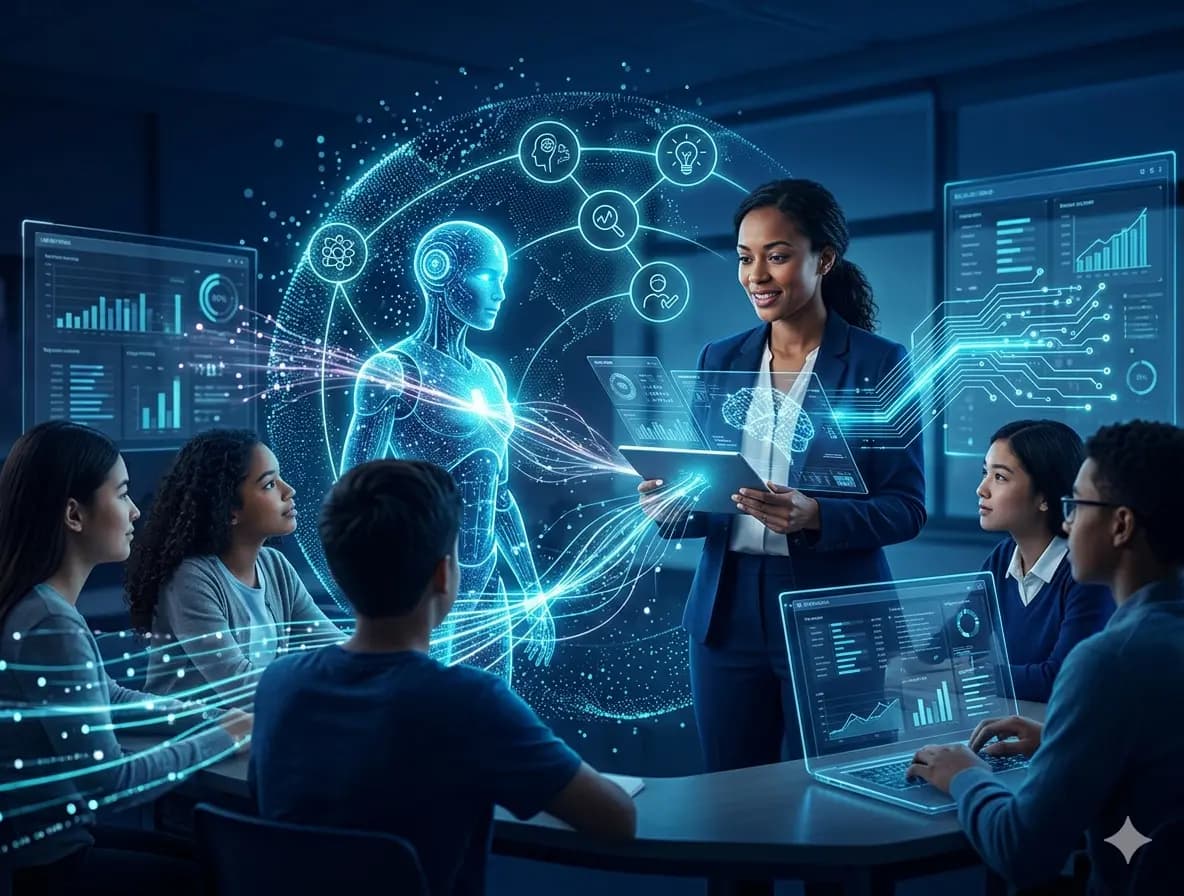
For years, people have repeated the same prediction: AI will replace teachers. It sounds dramatic. It sounds efficient. And it sounds modern.
But it is also deeply incomplete.
In 2026, the real shift in education is not that teachers are disappearing. It is that their role is being redefined. As AI becomes more capable of delivering information, summarizing lessons, grading simple assignments, and even personalizing parts of instruction, the value of teachers moves to a higher level.
Great teachers were never valuable only because they could transfer content. They were valuable because they could shape attention, build trust, create meaning, and guide human growth.
That is exactly why AI will not replace the best educators. It will reveal more clearly what makes them essential.
Why the Teacher Role Is Changing
For a long time, many education systems were built around one central assumption: the teacher is the primary source of knowledge in the room.
That assumption is now under pressure.
Students can already ask AI tools for explanations, summaries, examples, translations, and instant feedback. In many cases, they can access information faster than ever before. This changes the mechanics of teaching, especially in content-heavy environments where memorization and one-way delivery used to dominate the classroom.
But when access to information becomes easier, the real challenge shifts.
The new question is no longer, “Who can deliver content?”
The new question is, “Who can help learners interpret, apply, question, and transform that content into judgment?”
That is where the future of teachers becomes more important, not less.
From Information Delivery to Learning Leadership
AI is strong at speed. It can generate explanations in seconds. It can adapt wording. It can provide multiple versions of the same answer. It can support repetition without fatigue.
But learning is not the same as information access.
Real learning requires structure, emotional safety, curiosity, context, motivation, reflection, and accountability. These are not secondary functions. They are the core conditions that determine whether knowledge actually becomes capability.
This is why great educators in 2026 will increasingly move from being content deliverers to becoming learning leaders.
A learning leader does more than explain. A learning leader designs the journey.
They know when a student needs challenge and when they need reassurance. They know how to create momentum inside a classroom. They know how to turn confusion into inquiry and information into understanding. They do not only answer questions. They shape the quality of the questions being asked.
That kind of leadership cannot be automated in any meaningful human sense.
Teachers as Mentors and Architects
One of the biggest mistakes in conversations about AI in education is assuming that teaching is a purely technical function.
It is not.
The best teachers operate as mentors, interpreters, and architects of development. They do not simply give students knowledge. They help students build identity, confidence, and direction.
In practical terms, this means the future teacher will increasingly take on four roles:
1. The Teacher as a Sense-Maker
AI can provide answers. But students still need help understanding what matters, what is credible, what connects, and what deserves deeper thought.
Great teachers help learners make sense of complexity. They reduce noise. They organize scattered information into coherent insight.
2. The Teacher as a Learning Designer
In the past, many classrooms relied on linear delivery. In the future, stronger educators will design more intentional learning experiences.
They will know when to use AI for support and when to slow students down for reflection, discussion, or deeper struggle. They will design learning not just for completion, but for transformation.
3. The Teacher as a Mentor
Students do not only need explanations. They need encouragement, standards, emotional guidance, and belief.
AI can simulate encouragement. But it does not carry lived responsibility. A real teacher sees a learner over time. A real teacher notices patterns, effort, fear, growth, resistance, and potential.
That continuity matters.
4. The Teacher as a Builder of Judgment
The modern world does not only suffer from lack of information. It suffers from overload, distraction, and shallow certainty.
Students need judgment more than they need endless answers. They need to know how to evaluate ideas, challenge assumptions, communicate clearly, and act responsibly.
That is one of the highest-value contributions a teacher can make in the AI era.
Why Human Trust Still Matters
Education is not a software transaction. It is a human relationship.
The strongest teachers influence students not only because of what they know, but because of the trust they create. Learners often take intellectual risks when they feel psychologically safe. They ask better questions when they feel respected. They grow faster when they believe someone truly sees their potential.
This is where AI remains limited.
AI can respond intelligently, but it does not genuinely stand in relationship. It does not hold moral responsibility. It does not model character through lived example. It does not embody discipline, patience, integrity, or care in the way a real educator can.
Trust is not a small detail in education. It is a core infrastructure.
As technology expands, trust will become even more valuable. And teachers who can create that trust will become central figures in future learning environments.
What Great Teaching Looks Like Now
If AI is changing the classroom, then great teaching must also evolve.
In 2026, excellent teaching will likely look less like constant lecturing and more like intentional orchestration.
A strong teacher will know how to:
- use AI as a support tool without letting it dominate the learning process
- guide students to ask better questions, not just get faster answers
- create classroom discussion that deepens interpretation and critical thinking
- design assignments that require reflection, originality, and application
- help students distinguish between convenience and understanding
- cultivate responsibility, ethics, and intellectual maturity
This is an important distinction.
The presence of AI does not lower the standard for educators. It raises it.
Teachers are now being invited into a more advanced version of their profession. The routine parts of teaching may be reduced. But the strategic, relational, and developmental parts become more visible and more valuable.
AI Will Expose the Difference Between Average Teaching and Great Teaching
One uncomfortable truth about AI is that it may replace some low-value educational habits.
If a teacher only repeats textbook information, reads slides, and evaluates learning through shallow recall, then yes, AI will challenge that role. Students may reasonably ask why that function cannot be handled by a tool.
But that does not mean teaching as a profession becomes irrelevant.
It means the profession is being purified.
AI will expose the difference between teaching that only transfers information and teaching that creates growth.
Average teaching may become easier to automate. Great teaching will become easier to recognize.
And that matters for institutions as well. Schools, colleges, and education systems that understand this shift will invest differently. They will not position teachers as outdated content providers. They will position them as high-value guides in a complex learning ecosystem.
The Future of Teachers Is More Strategic, Not Less Human
There is a common fear that technology makes education colder. In some cases, it might.
But when used well, AI does not have to remove humanity from education. It can remove friction so that human educators can focus on higher-value work.
That is the opportunity.
The future of teachers is not about competing with machines at speed. Machines will win that contest. The future is about doing what only thoughtful humans can do: guiding meaning, building trust, shaping character, designing learning, and helping others grow into wiser versions of themselves.
The teacher of the future is not smaller than before.
The teacher of the future is more strategic than before.
Final Thoughts
In 2026, great teachers will not be replaced by AI. They will be redefined.
This redefinition is not a loss of relevance. It is a clarification of purpose.
As AI takes over more routine educational tasks, the true value of educators becomes easier to see. The best teachers will not be those who simply know the most. They will be the ones who can lead learning, build trust, mentor growth, and develop judgment in a world full of noise.
The future of education still needs technology.
But even more than that, it still needs great teachers.


