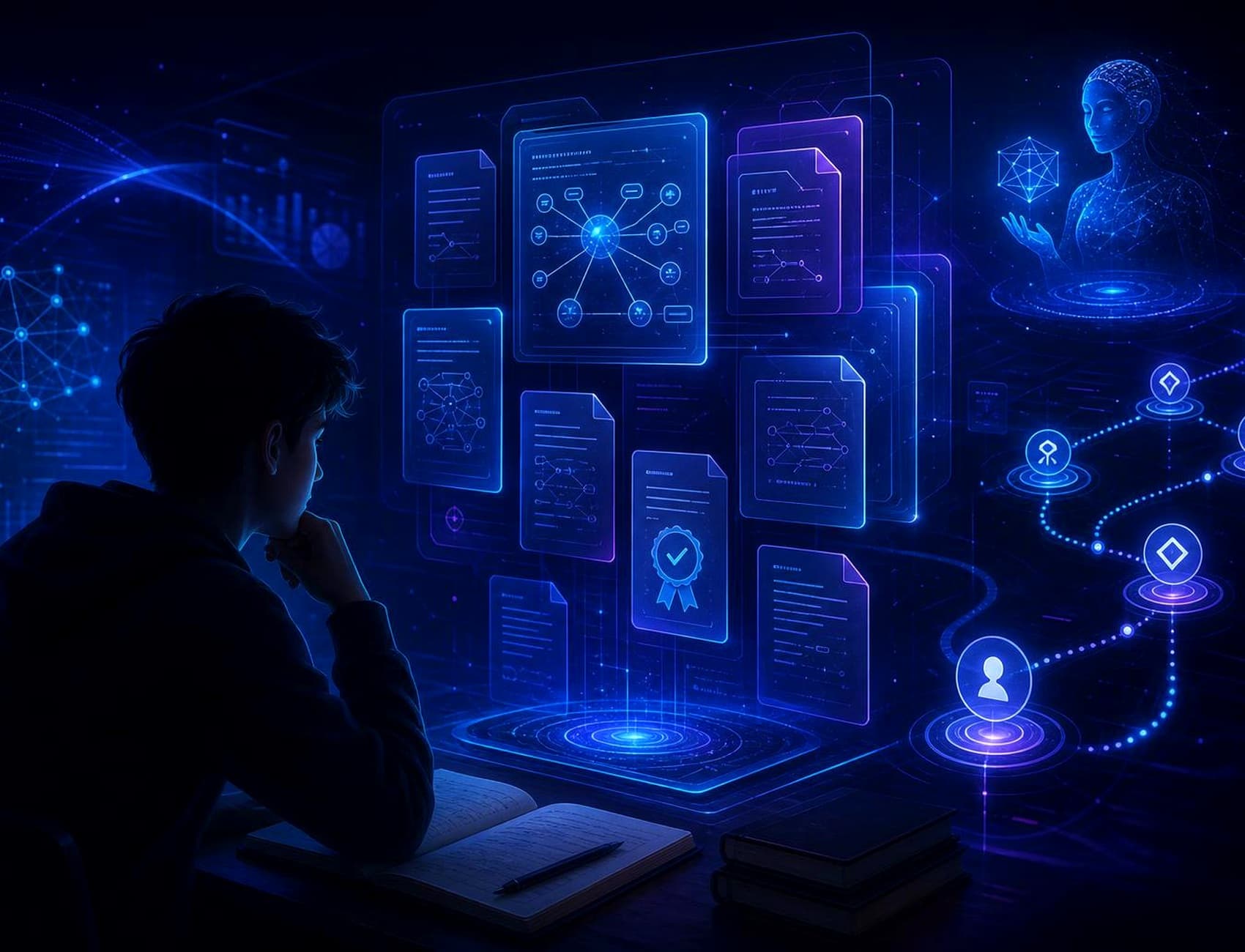
Many education systems are still responding to AI through policies. They define what students can use, what they must disclose, which tools are allowed, and what counts as misconduct. These policies matter. Institutions need boundaries.
But policies alone cannot show whether learning is happening.
In the AI era, students can produce polished answers faster than ever. They can summarize, rewrite, translate, brainstorm, structure, and edit with powerful assistance. This changes the evidence problem in education.
If the final output is no longer enough to reveal the student's thinking, educators need a richer way to see learning.
That is why education needs learning portfolios, not only AI policies.
The Policy Response Is Incomplete
AI policies usually focus on permission and restriction. They answer questions such as: Can students use AI? Must they cite it? Which assignments prohibit it? What happens if they hide usage?
These are necessary governance questions. But they do not fully address the learning question.
A student may follow the policy and still learn very little. Another student may use AI extensively but also demonstrate strong judgment, revision, source evaluation, and conceptual understanding.
The presence or absence of AI use is not the deepest signal. The deeper signal is how the student thinks with, against, and beyond the tool.
Policies manage behavior. Portfolios reveal development.
Why Final Products Are Less Reliable
Traditional assessment often relies heavily on final products: essays, reports, presentations, answers, projects, or exams. These outputs still matter, but AI makes them less sufficient as standalone evidence.
A final essay may look fluent without showing whether the student understood the argument. A presentation may look professional without showing how decisions were made. A report may be well structured without revealing whether the student evaluated the sources.
This does not mean every AI-assisted output is dishonest or worthless. It means educators need to look beyond the surface of completion.
The question should shift from "Did the student produce a good output?" to "Can the student show the path of learning that led to the output?"
What a Learning Portfolio Does
A learning portfolio collects evidence of thinking over time.
It can include drafts, reflections, prompt logs, source comparisons, teacher feedback, peer critique, revision notes, concept maps, mistakes, alternative versions, and final synthesis. The purpose is not to create administrative burden. The purpose is to make learning visible.
In an AI-rich environment, a portfolio helps answer questions that the final product cannot answer alone.
What did the student ask? What did the AI misunderstand? Which sources did the student trust or reject? What assumptions changed? What feedback improved the work? What revisions were made and why? What can the student now explain without assistance?
These questions turn assessment from output inspection into learning diagnosis.
The Portfolio as an AI Literacy System
A good learning portfolio does more than document work. It trains habits.
Students learn to track their reasoning. They learn to compare machine output with human judgment. They learn to notice weak claims, missing evidence, vague concepts, and unsupported conclusions. They learn that revision is not decoration, but thinking made visible.
This is a better foundation for AI literacy than tool instruction alone.
Tool instruction teaches students how to operate AI. Portfolio practice teaches students how to evaluate their own learning while using AI.
The difference matters because tools will change. The habit of disciplined reflection should remain.
What Educators Can Include
A practical AI-era learning portfolio does not need to be complicated.
First, include an inquiry record. Students state the question they are exploring and why it matters. This prevents AI use from becoming answer-hunting without purpose.
Second, include an AI interaction record. Students summarize how they used AI, what prompts or instructions mattered, and where the tool was helpful or weak.
Third, include a verification record. Students identify which claims were checked, which sources were compared, and what changed after verification.
Fourth, include revision evidence. Students show how the work evolved from first draft to final version, including what was removed, clarified, or restructured.
Fifth, include a reflection note. Students explain what they understand better now and what remains uncertain.
These elements do not punish AI use. They make AI use intellectually accountable.
Assessment Must Value the Process
Learning portfolios will fail if educators treat them as decoration beside the final grade.
The process must count.
Students should be rewarded for asking better questions, identifying weak assumptions, improving structure, correcting errors, and explaining their decisions. This changes the incentive system. Instead of optimizing only for a polished final answer, students learn to optimize for visible growth.
This also helps teachers distinguish between dependence and development.
Dependence looks like outsourcing the work to AI and accepting the result. Development looks like using AI as input, then applying judgment, critique, revision, and synthesis.
Portfolios make that difference easier to see.
Final Thought
AI policies are necessary, but they are not enough.
Education needs rules for responsible use. It also needs evidence systems that show how students are learning in a world where polished output is easy to generate.
Learning portfolios provide that evidence.
They help students build the habits that matter most in the AI era: inquiry, verification, revision, reflection, and ownership of thought.
The future of education will not be protected by policy alone. It will be strengthened by better ways of seeing learning.
Key Takeaways
- AI Policies can be useful, but it becomes limited when it is not connected to learning portfolios.
- The deeper advantage comes from clearer standards, stronger judgment, and a more intentional operating system.
- Educators should treat this as a practical capability, not only an abstract idea.
FAQ
Why does learning portfolios matter?
Learning Portfolios matters because it helps educators move beyond surface activity and build a more durable system for judgment, execution, and trust.
Why is ai policies not enough?
AI Policies may improve visible activity, but it does not automatically solve the deeper problem of clarity, accountability, and long-term capability.
How should educators apply this idea?
They should define the standard behind the work, review where the current system breaks down, and turn the insight into a repeatable practice.


