AI literacy is important. But it is not enough.
Many schools, universities, and training organizations are now trying to teach students and teachers how to use AI responsibly. They create policies, workshops, prompt guides, tool lists, and classroom rules. These efforts are necessary. But if they remain isolated, they will not create deep educational transformation.
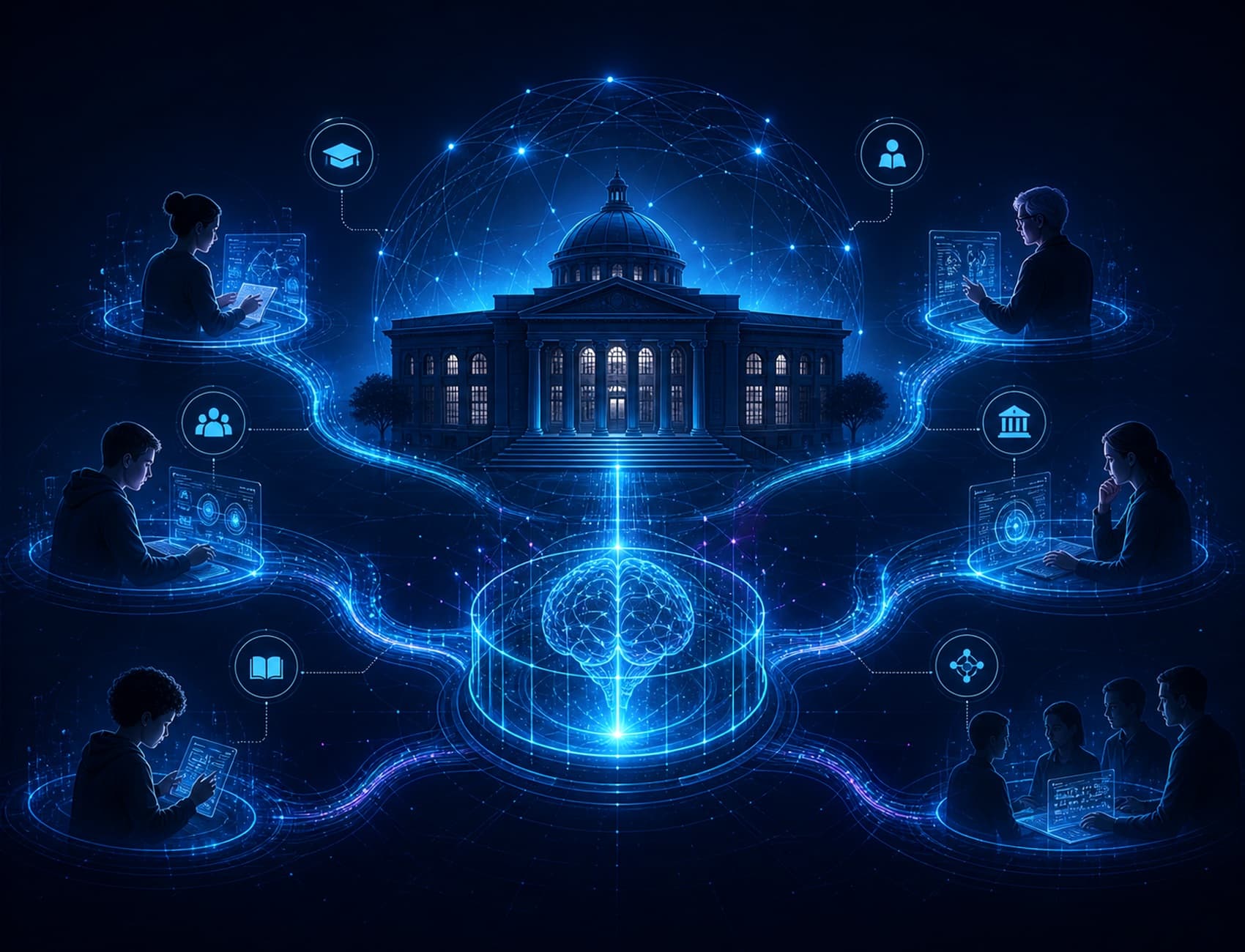
The deeper challenge is institutional learning.
Education does not only need individuals who understand AI. It needs institutions that can learn from AI use, update their standards, redesign assessment, support teachers, and adapt their systems over time.
Without institutional learning, AI literacy becomes a short training session in a system that has not changed.
The Misconception: AI Literacy Solves the Education Problem
AI literacy is often framed as the core solution.
Teach students how AI works. Teach teachers how to prompt. Teach everyone about bias, hallucination, citation, privacy, and responsible use.
All of this matters.
But AI literacy alone assumes that the main problem is individual capability. If teachers and students understand AI better, the education system will adapt.
That assumption is incomplete.
Education is not only a collection of individual users. It is an institutional system: curriculum, assessment, policy, teacher workload, academic integrity, learning culture, leadership expectations, technology infrastructure, and public trust.
If the institution does not learn, individual AI literacy has limited power.
Why Institutions Must Learn, Not Only Train
Training transfers knowledge. Learning changes behavior.
An institution that only trains people may run workshops every semester while keeping the same assessment model, the same grading logic, the same teacher support structure, and the same definition of academic performance.
An institution that learns asks deeper questions:
- Which assignments no longer measure real thinking?
- Which forms of AI use should be encouraged?
- Which teacher roles need redesign?
- Which student capabilities matter more now?
- Which policies are creating fear instead of responsibility?
- What evidence shows whether learning is improving?
This is not a one-time policy update. It is a learning loop.
The Deeper Issue: AI Exposes Old Weaknesses in Education
AI did not create the deepest problems in education. It revealed them.
If an assessment can be completed by AI without much thinking, the problem is not only cheating. The problem is that the assessment may have been measuring output more than cognition.
If teachers feel overwhelmed by AI policy, the problem is not only technology complexity. The problem may be that institutions are asking teachers to redesign learning without giving them time, support, or shared standards.
If students use AI passively, the problem is not only tool misuse. The problem may be that the learning culture rewards completion more than intellectual ownership.
AI makes these weaknesses harder to ignore.
That is why institutions need learning systems, not only literacy programs.
What Institutional Learning Looks Like
Institutional learning means the organization can observe what is happening, interpret it honestly, and improve its design.
In education, this requires several layers.
1. Learning Evidence
Schools need evidence of how AI is affecting learning, not just whether students are using it.
Useful questions include:
- Are students becoming better at questioning?
- Are they improving in explanation, synthesis, and judgment?
- Are they using AI to avoid thinking or to deepen thinking?
- Which assignments produce meaningful learning with AI?
- Which tasks have become obsolete?
The institution should collect patterns from classrooms, not only violations from academic integrity cases.
2. Teacher Feedback Loops
Teachers are the closest observers of how AI changes learning behavior.
But many institutions treat teachers as policy implementers, not learning partners.
A stronger approach would create structured feedback loops:
- What are teachers seeing?
- Which student behaviors are emerging?
- Which assessment designs are failing?
- Which classroom practices are working?
- What support do teachers need next?
Teacher experience should become institutional intelligence.
3. Assessment Redesign
AI forces education to clarify what it wants to measure.
If the goal is recall, AI disrupts the task. If the goal is reasoning, critique, application, reflection, and transfer, AI can become part of a richer learning design.
Institutions should not respond only by banning tools. They should redesign assessment around visible thinking.
This may include:
- oral defense
- process journals
- annotated drafts
- reflection on AI use
- source evaluation
- problem-based tasks
- in-class reasoning activities
- portfolios of learning development
The point is not to make cheating impossible. The point is to make thinking more visible.
4. Policy as a Learning Document
AI policies should not be static documents.
They should evolve as the institution learns. A policy created in early AI adoption may quickly become outdated because tools, student behavior, and teaching practices change.
Good policy should define principles, not only prohibitions.
It should help people understand:
- when AI use is allowed
- when disclosure is required
- what responsible support looks like
- where human authorship matters
- how students should document their process
- how teachers can adapt assignments
Policy should guide judgment, not simply create fear.
A Practical Framework for Education Leaders
Education leaders can begin with a simple institutional learning cycle.
1. Observe
Collect classroom realities, teacher feedback, student behavior, assignment outcomes, and examples of effective AI-supported learning.
2. Interpret
Ask what these patterns mean for assessment, curriculum, teacher roles, student capability, and academic standards.
3. Redesign
Update assignments, policies, teacher support, and learning outcomes based on evidence.
4. Share
Turn local experiments into institutional knowledge. Do not let good practices remain isolated in individual classrooms.
5. Repeat
AI adoption will not stabilize quickly. Institutions need a rhythm of review and adaptation.
Conclusion
AI literacy teaches people how to use powerful tools. Institutional learning teaches education systems how to evolve around those tools.
Both are necessary. But they are not the same.
If education stops at AI literacy, it may create better-informed users inside outdated systems. If education builds institutional learning, it can redesign the relationship between technology, teaching, assessment, and human development.
The future-ready institution will not be the one with the longest AI policy or the most tool workshops.
It will be the one that can learn faster, judge better, and redesign more honestly.
Key Takeaways
- AI literacy is necessary, but education also needs institutional learning.
- AI exposes weaknesses in assessment, policy, teacher support, and learning culture.
- Institutions should collect classroom evidence and turn teacher experience into shared intelligence.
- Strong education systems will redesign assessment around visible thinking and responsible AI use.
FAQ
What is institutional learning in education?
Institutional learning is the ability of an education organization to observe, interpret, and redesign its systems based on evidence from teaching and learning practice.
Why is AI literacy not enough?
AI literacy improves individual understanding, but it does not automatically change assessment, curriculum, teacher support, policy, or institutional behavior.
How can schools respond to AI more effectively?
Schools can build feedback loops, redesign assessment, update policies regularly, support teachers, and evaluate whether AI use is improving real learning.


