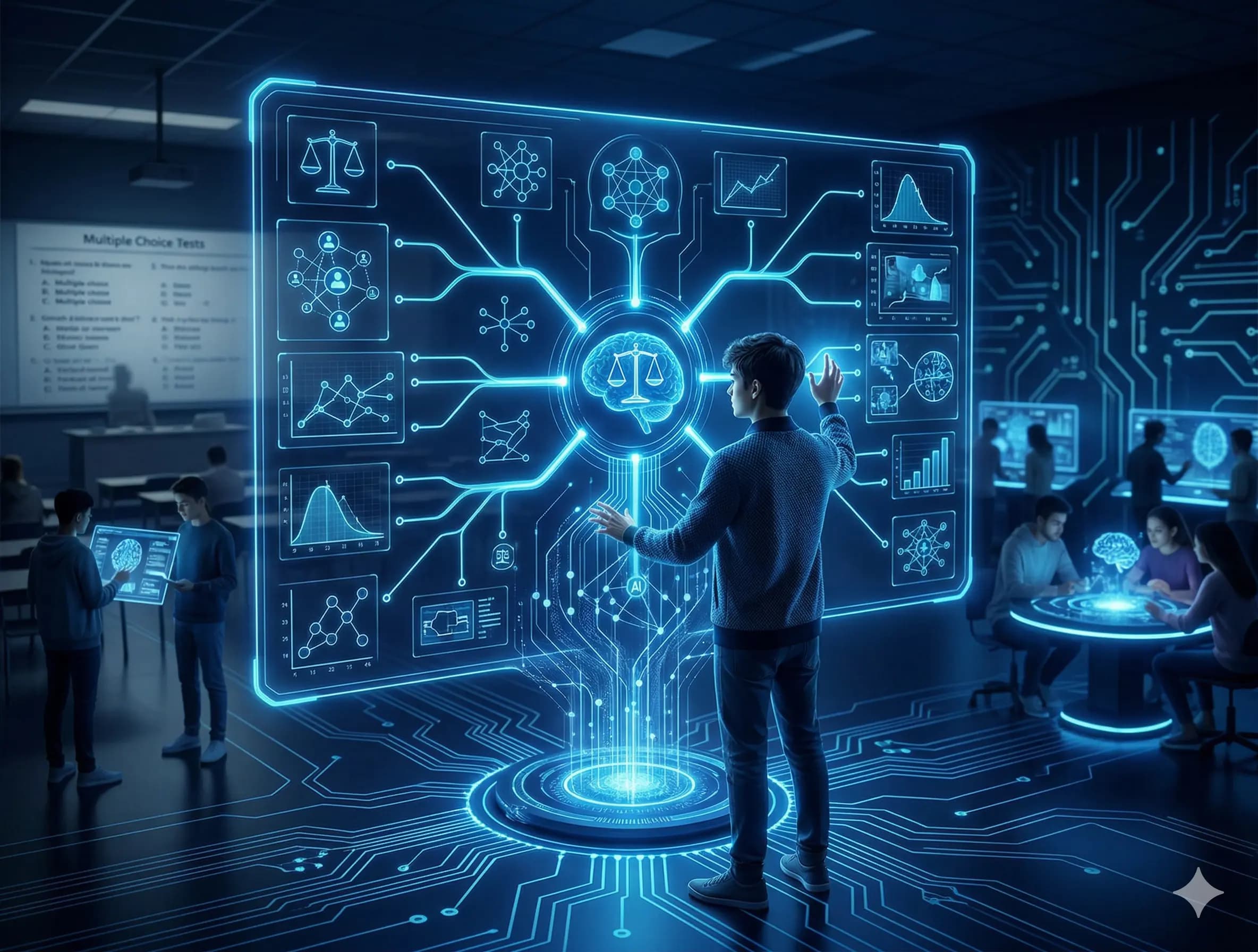
The most dangerous student is not the one who does not know enough. It is the one who knows just enough to be confidently wrong, yet has never been taught to doubt themselves at the right moment.
I have seen this pattern in classrooms, in boardrooms, and even in hiring decisions. Someone with impressive credentials enters a situation that demands judgment under uncertainty, and suddenly the confidence collapses. Or worse, it hardens into certainty in the wrong direction. They were taught how to arrive at the correct answer when the structure was clear, the method was known, and the question had already been framed for them. But they were never trained for the moments when the right answer is not obvious, when two interpretations are both plausible, or when the real task is not solving the problem but understanding what the problem actually is.
That gap is not merely an individual weakness. It is a structural weakness in the way education has been designed for decades.
And in a world where information is everywhere, that weakness becomes more costly every year.
The best education, therefore, does not only teach answers. It trains judgment.
Why Answer-Based Learning Is Not Enough
Answer-based learning once made sense.
There was a time when access to reliable information was limited, textbooks were gatekeepers, libraries were essential, and teachers held a form of intellectual authority that students could not easily replace. In that context, memorization and recall had real value. Schools functioned as systems for distributing knowledge, and students who could retain and reproduce that knowledge were considered well-prepared.
But that is no longer the world we live in.
Today, the bottleneck is not access to answers. The bottleneck is the ability to evaluate them.
A student can now retrieve an answer to almost any question in seconds. A search engine can provide ten versions of an explanation. An AI system can generate a polished response instantly. But the presence of an answer does not guarantee the presence of understanding. It does not guarantee relevance, reliability, depth, or wisdom.
That is where answer-based learning begins to fail.
It often rewards students for speed rather than reflection. It trains them to optimize for correctness within a predefined framework, rather than to question the framework itself. It prepares them for examinations more effectively than for reality.
And reality rarely behaves like an exam.
In real life, the most consequential decisions do not arrive as cleanly framed multiple-choice questions. They arrive with ambiguity, incomplete information, competing incentives, unclear trade-offs, and real consequences.
An education that only trains students to retrieve answers is training them for a world that no longer exists.
Judgment as a Core Educational Goal
If answers are increasingly accessible, then what becomes more valuable?
Judgment.
Judgment is the capacity to think clearly when certainty is unavailable. It is the ability to weigh competing considerations, detect what matters most, make decisions with incomplete information, and remain intellectually responsible for the consequences.
This is not a vague soft skill. It is one of the most practical and essential human capacities in the modern world.
A person with knowledge but poor judgment may still make damaging decisions. A person with intelligence but no discernment may still be manipulated by confidence, novelty, or superficial logic. A person with strong academic training but weak judgment may perform well in structured environments and still fail when the situation becomes unclear, political, or morally complex.
That is why judgment should not be treated as an abstract ideal. It should be treated as a core educational outcome.
A serious education should not only ask whether students can produce the answer. It should also ask whether they can interpret, challenge, evaluate, and apply what they know in conditions that are less predictable.
Because that is what life will ask of them.
Information Is Abundant. Discernment Is Rare
One of the defining realities of modern education is this: students do not suffer from a lack of information. They suffer from an excess of it.
They live in an environment of constant input. Articles, videos, summaries, podcasts, AI outputs, social media commentary, and expert opinions are available almost instantly. At first glance, this appears to be a historic advantage.
But abundance alone does not create insight.
Without discernment, abundance becomes overload.
Discernment is the ability to distinguish what is credible from what is merely persuasive, what is relevant from what is distracting, and what is evidence from what is assertion. It is the ability to recognize the difference between something that sounds intelligent and something that is actually well-founded.
This is one of the rarest educational capacities today, precisely because it is often assumed rather than explicitly taught.
Many systems still operate as if exposure to information will naturally produce critical thinking. It does not. In many cases, it simply produces faster confusion, stronger bias, or the illusion of understanding.
Students are often rewarded for sounding informed long before they are trained to think rigorously.
That is a dangerous imbalance.
The students who will think most clearly in the years ahead will not necessarily be those who consume the most information. They will be those who habitually ask better questions:
- Where does this claim come from?
- What assumptions does it rely on?
- What evidence supports it?
- What does it leave out?
- What would change my mind?
Those questions are not decorative. They are the architecture of discernment.
Why Discernment Must Be Taught Directly
One of the biggest misconceptions in education is the belief that critical thinking emerges automatically from exposure to quality content.
It does not.
Discernment is not a passive byproduct. It is a skill that requires direct instruction, repeated practice, and environments that reward thoughtfulness over performance.
A history class, for example, does not develop judgment simply because it contains historical facts. It develops judgment when students are asked to examine conflicting interpretations, compare sources, identify omissions, and defend why one account is stronger than another.
A science class does not build discernment simply because it teaches scientific knowledge. It does so when students learn to distinguish evidence from speculation, correlation from causation, and good reasoning from attractive conclusions.
The same principle applies across every discipline that matters.
The content may differ, but the deeper cognitive demand remains the same: not merely to know, but to evaluate.
And that shift changes everything.
How Teachers Can Develop Better Thinkers
The challenge, of course, is practical. Many teachers already work under real constraints: standardized testing, curriculum pressure, large class sizes, inconsistent student preparation, and institutional systems that still reward measurable recall more easily than mature judgment.
Yet even within those constraints, more is possible than many assume.
Make reasoning visible, not just answers
When a student arrives at the correct answer, the instinct is often to move on. But the richer educational moment lies in asking how they got there.
What alternatives did they consider?
What did they reject, and why?
What evidence shaped their conclusion?
What would make them revise it?
These questions reveal whether the student is actually thinking or merely pattern-matching. They also shift the focus of learning from answer production to reasoning quality.
Introduce genuine disagreement
Students who only encounter problems with tidy solutions are unprepared for the most important problems in real life.
Teachers should create intellectual contact with real disagreement, not artificial debate for performance, but genuine tension between competing interpretations, values, or frameworks. Students need experience thinking through situations where intelligent people reasonably disagree and where the task is not to memorize the official answer, but to reason responsibly through complexity.
That is one of the strongest ways to train judgment.
Teach evaluation as a transferable skill
Students should be taught explicitly what strong reasoning looks like and what weak reasoning looks like.
They should learn how to evaluate an argument even when they emotionally agree with it. They should learn how to identify flawed logic even when the conclusion sounds appealing. They should learn that evidence quality matters more than rhetorical confidence.
This is not only an academic skill. It is a life skill.
A person who can evaluate reasoning clearly becomes harder to manipulate, more thoughtful in decision-making, and more capable of leadership.
Reward productive uncertainty
Many students have internalized the idea that uncertainty is a weakness. They feel pressured to answer quickly, sound sure, and avoid intellectual hesitation.
But real thinkers do something different.
They understand that uncertainty, when handled properly, is not incompetence. It is honesty. It is precision. It is often the beginning of better thought.
Students should be rewarded not only for knowing, but also for knowing the limits of what they know. “I am not certain, and here is why” is often a far more intelligent response than a polished but inaccurate answer.
Model intellectual humility
Students learn judgment not only through instruction but through example.
A teacher who models curiosity, fairness, openness to revision, and care in making claims teaches something deeper than content. They teach what mature thinking looks like in practice.
This matters more than many systems acknowledge.
Because judgment is not only cognitive. It is also ethical. It involves how one relates to truth, uncertainty, evidence, and responsibility.
What Real Education Produces
The measure of education should not be what a student can repeat at graduation. It should be what that student can navigate years later, when the problems are unfamiliar, the stakes are real, and no answer key exists.
That is the real test.
The students who will navigate such moments best are not necessarily the ones with the highest scores. They are the ones who have learned to think without rushing, to update their views when evidence changes, to notice what others overlook, and to act decisively even when certainty is impossible.
That capacity is not built through memorization alone.
It is built through repeated practice in interpretation, reflection, evaluation, and intellectual responsibility.
Real education produces people who can think beyond the script.
It produces people who can slow down before accepting the obvious conclusion. People who can distinguish confidence from competence. People who can recognize when the question itself is poorly framed. People who can remain thoughtful under pressure.
In a world increasingly shaped by automation, AI, and instant access to content, this becomes even more important.
Because when answers become cheap, judgment becomes priceless.
Education in the Age of AI
This point becomes sharper in the age of AI.
AI can generate summaries, solve routine problems, explain concepts, and produce fluent responses at scale. This creates enormous opportunities for learning. But it also introduces a new danger: students may confuse immediate output with actual understanding.
A fluent answer can still be shallow.
A convincing explanation can still be incomplete.
A structured response can still be wrong.
That is why the educational question is no longer whether students should use AI. The more important question is whether they are being trained to judge AI outputs intelligently.
If students are educated only to receive answers, AI may simply accelerate passivity.
If they are educated to question, interpret, verify, and think critically, then AI becomes a powerful partner in learning rather than a substitute for thought.
This is the distinction that matters.
The future of education is not simply more digital. It must be more discerning.
Final Thought
The purpose of education is not merely to fill minds with information. It is to shape minds that can use information wisely.
Answers matter. Knowledge matters. Accuracy matters.
But none of them are enough on their own.
The best education does not only teach students what to think about. It develops their capacity to think with depth, to judge with care, and to act with maturity in a world that rarely offers certainty.
In the years ahead, that may be the single most important distinction between schooling that looks impressive and education that actually prepares people for life.
Because in a world full of answers, the rarest and most valuable skill is still judgment.


