For the last two years, most AI conversations have focused on one visible skill: prompting.
People learned how to ask better questions, structure instructions more clearly, and refine wording until the model produced stronger outputs. That shift mattered. It helped many professionals move faster and get more value from AI.
But the market is already moving beyond that stage.
The next meaningful advantage will not belong to the person who can write the cleverest prompt. It will belong to the person who can design a system where AI plays a clear, repeatable role inside a larger process.
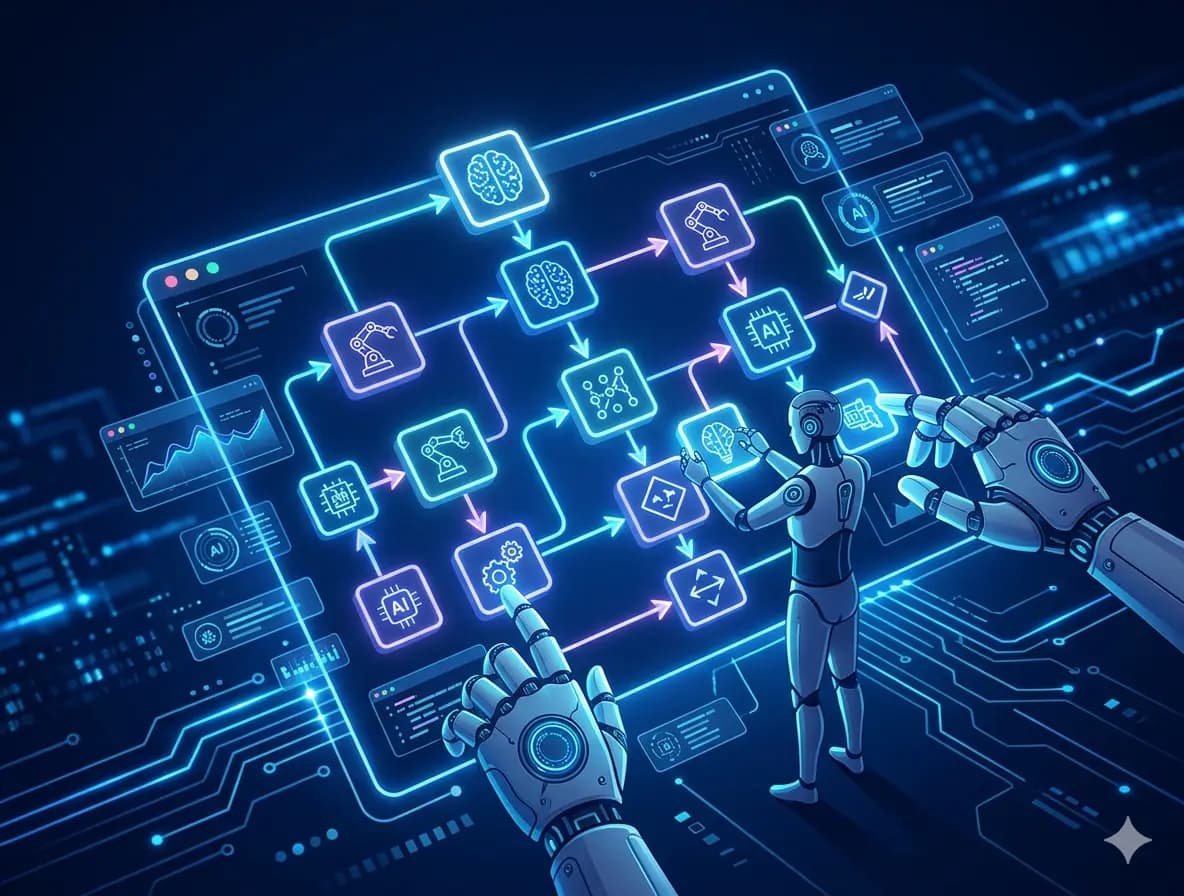
That is why the next AI skill is workflow design .
A prompt can improve one interaction. AI workflow design improves how work moves from input to outcome across multiple steps. It creates leverage, consistency, and scale. In modern work, that is far more valuable than isolated prompt quality.
Why Prompting Alone Is No Longer Enough
A strong prompt can produce a strong output. That is useful. But most real work is not one output.
Real work is usually a chain of actions: research, analysis, drafting, review, refinement, approval, distribution, and iteration. Each stage depends on the one before it. Each stage creates material for the next.
That is where prompting starts to show its limits.
If you use AI only as a one-step generator, you may improve speed at individual moments, but you still rely on manual thinking to connect everything together. You are faster, but the structure of the work has not changed.
AI workflow design changes that structure.
It asks a different question. Not, “How do I get a better answer from AI right now?” but, “How should this entire process be designed so AI can support it repeatedly and effectively?”
That shift is what separates casual AI use from strategic AI capability.
A Good Prompt Helps Once. A Good Workflow Compounds
This is the clearest difference.
A person who is good at prompting may get:
- a better summary
- a cleaner first draft
- a sharper brainstorm
- a faster response
- A person who understands AI workflow design builds a system where
- inputs are structured before AI touches them
- AI handles repeatable transformations
- human review happens only at high-value points
- outputs are formatted for immediate downstream use
- the process can be reused without starting from zero
One improves a task. The other improves capacity.
That is why workflow design matters more. It compounds over time.
What AI Workflow Design Actually Means
At its core, AI workflow design is the ability to structure how work flows from problem to result.
It means defining:
- what the starting input is
- what transformations need to happen
- where AI adds value
- where human judgment is required
- what output format is needed
- how the process can be repeated reliably
This is not just about automation. It is about process architecture.
The strongest AI users do not simply talk to AI better. They build pathways where AI supports thinking, execution, and decision-making in a controlled way.
That is a more mature skill than prompting alone.
The Inputs, Process, Outputs Framework
A simple way to understand AI workflow design is through three layers: inputs, process, and outputs.
Inputs
Inputs are the raw materials entering the workflow.
These might include:
- a campaign brief
- a meeting transcript
- a research document
- a client request
- a content idea
- internal data or performance notes
Many workflows fail because the inputs are vague, incomplete, or inconsistent. If the information entering the system is weak, the output quality will remain unstable no matter how advanced the model is.
Good workflow design starts by clarifying what input quality is required.
Process
The process is the sequence of steps that transforms raw material into something useful.
This is where AI can help most, but not everywhere equally.
Some steps are mechanical and benefit from AI immediately. Others require human judgment, context, taste, or strategic interpretation. The real skill is knowing where each belongs.
The question is not “Can AI do this?” The better question is “Should AI do this here, and what should happen before and after?”
That is a workflow designer’s mindset.
Outputs
Outputs should not be defined vaguely.
Not “a summary,” but:
- a summary in three decision-ready bullets
- a weekly report with clear recommendations
- a blog outline aligned to search intent
- a lesson plan broken into time blocks
- a client-ready memo with action steps
The more clearly outputs are designed, the more useful and reusable the workflow becomes.
Where Human Judgment Should Stay
One of the biggest mistakes in AI adoption is placing human review everywhere.
That sounds safe, but it often makes the workflow slower and more cognitively expensive. Reviewing every AI-generated step can consume nearly as much energy as doing the work manually.
Strong AI workflow design places human attention at the moments that matter most:
- when important inputs must be defined correctly
- when strategic decisions are being made
- when external-facing outputs need final approval
- when the process branches and context matters
Everything else should be simplified, templated, or delegated where appropriate.
This does not remove humans from the system. It places human intelligence where it creates the most value.
Why Workflow Design Is a More Durable AI Skill
Prompting is still useful, but it is becoming less differentiating.
As AI tools improve, interfaces become more intuitive, and models get better at handling imperfect instructions, the value of basic prompt skill naturally declines. What used to feel advanced becomes normal.
But AI workflow design becomes more valuable as AI matures.
Why?
Because workflow design is not just a tool skill. It is a systems skill.
It requires:
- process thinking
- logic
- operational clarity
- decision architecture
- understanding of where quality is created
- awareness of where friction slows teams down
These are deeper capabilities. They do not disappear when a tool gets smarter.
In fact, the smarter AI becomes, the more important workflow design becomes. Better tools increase the returns for people who know how to place them correctly inside a process.
The Shift From Prompt Thinking to Process Thinking
This is the real mental transition happening in modern work.
Prompt thinking says:
- Can AI write this article?
- Can AI summarize this file?
- Can AI generate content for this campaign?
- Process thinking says
- How should content move from idea to publication?
- How should information move from raw file to strategic decision?
- How should campaign planning move from insight to execution and review?
The second way of thinking is much more powerful.
It treats AI as part of a system, not just as a response engine.
That is why AI workflow design is becoming such an important skill in marketing, education, operations, consulting, research, and leadership work.
What This Looks Like in Real Roles
Content Strategist
A prompt-based user asks AI to write one article.
A workflow designer creates a system where:
- a keyword becomes a topic angle
- the angle becomes an outline
- the outline becomes a draft
- the draft gets optimized for SEO
- the finished article becomes social snippets, metadata, and repurposed assets
That is not just faster writing. That is scalable content operations.
Marketing Leader
A prompt-based user asks AI to summarize campaign data.
A workflow designer builds a flow where:
- performance data is collected regularly
- market signals are synthesized
- campaign insights are organized into a digest
- key risks and opportunities are surfaced
- leadership only reviews the decisions that matter
That changes managerial capacity.
Founder or Consultant
A prompt-based user asks AI to draft a proposal.
A workflow designer creates a proposal system where:
- client discovery notes become a structured brief
- the brief becomes a proposal draft
- the proposal is checked against service logic and positioning
- the final document is shaped for presentation and follow-up
That improves consistency, speed, and quality under pressure.
Why the Best AI Users Are Becoming Workflow Designers
The highest-value AI users today are not just people who can “talk to AI well.”
They are people who can:
- break work into stages
- define useful handoffs
- reduce repetition
- standardize quality
- protect critical decision points
- create systems that improve with use
That is the essence of AI workflow design .
It turns AI from a helpful assistant into a force multiplier.
And that difference matters more every month.
How to Start Building This Skill
You do not need to become deeply technical to build AI workflow design capability.
You need to become more intentional about how work flows.
Start with one recurring task in your work and ask:
- What is the starting input?
- What steps happen repeatedly?
- Where do delays or confusion appear?
- Which parts require human judgment?
- Which parts are repetitive enough for AI support?
- What should the final output look like to be immediately useful?
Then begin designing around those answers.
Focus on:
- cleaner inputs
- clearer step sequences
- standardized prompts inside a broader system
- fewer unnecessary handoffs
- stronger output formats
- review only where it matters most
That is how AI moves from novelty to infrastructure.
The Future Belongs to People Who Can Design Flow
For a while, prompting looked like the headline skill of the AI era.
It was visible, easy to teach, and easy to sell. But it was never the final layer of value.
The deeper advantage was always going to belong to people who could structure work itself.
That is why AI workflow design is becoming the next critical skill.
Because the future of AI at work will not be defined by who writes the most impressive prompt.
It will be defined by who can build the clearest, smartest, most repeatable systems around real work.
Prompting may help you get a better answer.
Workflow design helps you build a better way of working.
And in the long run, that is the skill that wins.


