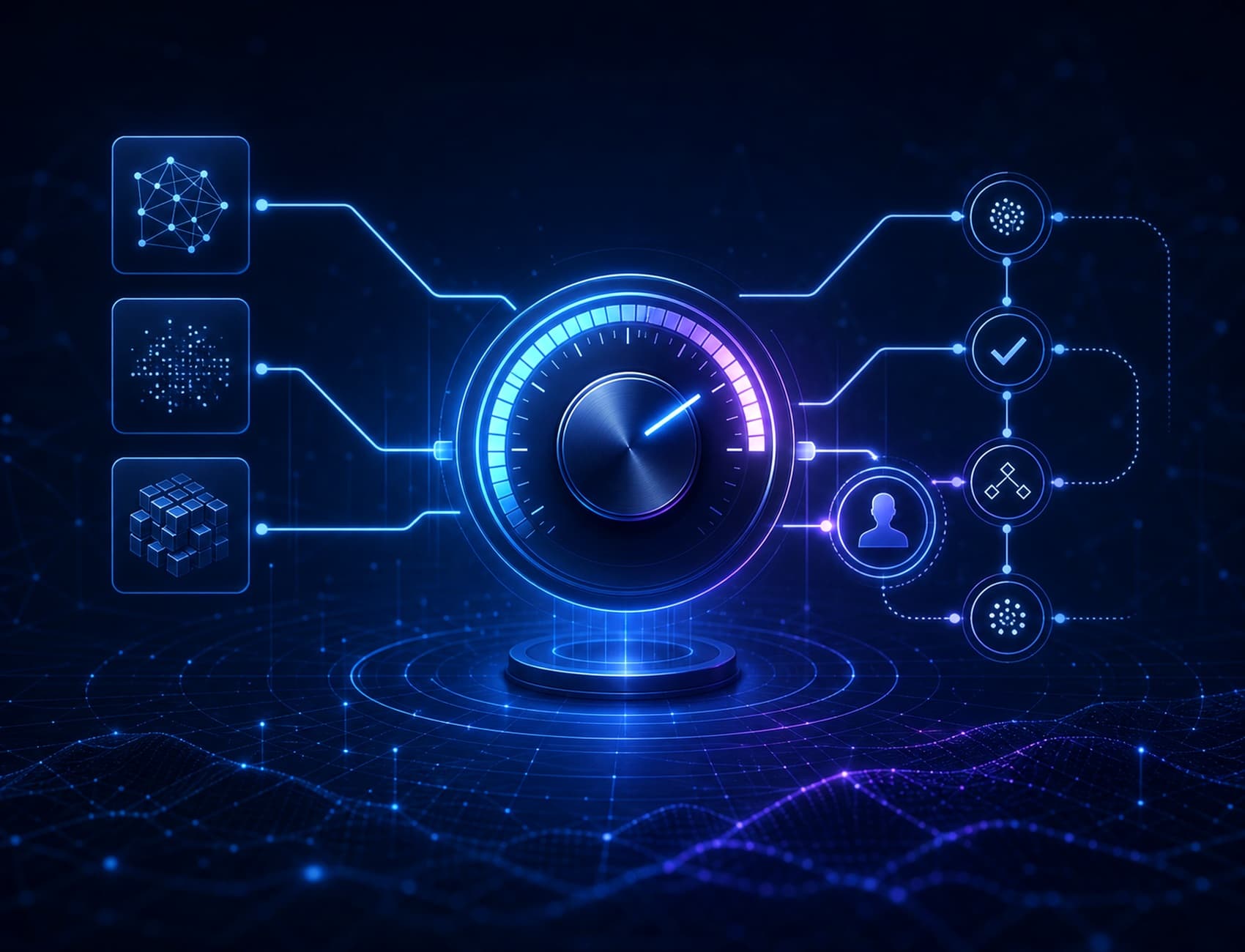
Most AI adoption fails quietly before it fails visibly.
The team may have access to better models. The workflow may look faster. The output may even appear more polished. But beneath that surface, a deeper problem often remains unresolved: the system does not know when it is right, when it is uncertain, and when a human should intervene.
That is not an automation problem. It is a calibration problem.
Automation asks, "Can this task be done faster?" Calibration asks, "How do we know whether the result is reliable enough for this decision?" The distinction matters because AI does not only increase productivity. It also increases the volume of plausible output. Without calibration, teams may move faster while becoming less aware of their own uncertainty.
The Misconception: Better Models Automatically Create Better Work
Many organizations treat AI quality as a model selection issue. If the output is weak, they assume the model must be upgraded, the prompt must be improved, or the tool must be replaced.
Sometimes that is true. But often the deeper issue is not the model. It is the absence of a judgment system around the model.
A more capable model can still produce work that is strategically wrong, contextually incomplete, legally risky, or operationally unusable. It can sound confident while missing the real constraint. It can summarize correctly but prioritize poorly. It can generate five options without knowing which one fits the business moment.
This is why model capability and organizational capability are not the same thing.
AI can produce. But the organization must still judge.
The Deeper Issue: AI Expands Output Faster Than It Expands Judgment
Before AI, teams were often limited by production capacity. They could only write so many drafts, analyze so many documents, or prepare so many variations.
AI changes that constraint. It makes production cheaper.
But when production becomes cheap, judgment becomes more expensive.
The bottleneck moves from "Can we create this?" to "Can we evaluate this well?" A team that does not notice this shift will become flooded with options, drafts, ideas, and recommendations without a mature way to rank them.
The result is not intelligence. It is output inflation.
Output inflation creates several risks:
- Teams confuse volume with progress.
- Managers approve work because it looks complete.
- Junior employees rely on AI confidence instead of developing standards.
- Strategic decisions become supported by polished but shallow reasoning.
- Errors travel further because they are embedded inside professional-looking material.
The problem is not that AI is unreliable. The problem is that many teams have not designed reliability checks into their AI workflows.
What Calibration Means in an AI System
Calibration is the discipline of aligning AI output with context, risk, confidence, and decision standards.
It is not merely quality control at the end. It is a workflow architecture that answers five questions:
- What level of accuracy does this task require?
- What kind of error would be dangerous?
- What evidence should support the output?
- When should the AI ask for human review?
- Who owns the final judgment?
Without these questions, AI systems become vague productivity machines. They may help people work faster, but they do not necessarily help people work better.
Why Calibration Matters More as AI Becomes More Capable
Weak AI systems are easy to distrust. Their mistakes are visible.
Strong AI systems are more complicated. Their outputs are fluent, structured, and persuasive. They can create a sense of confidence before the substance has been tested.
This is why the next stage of AI adoption will not be defined only by who has access to the strongest model. It will be defined by who has the strongest calibration layer.
1. Calibration Protects Decision Quality
AI output often enters decision-making processes: marketing plans, lesson designs, financial analysis, customer segmentation, hiring criteria, policy drafts, and strategy documents.
If the organization has no calibration standard, the output can shape decisions before anyone has properly challenged it.
Good calibration slows down the right moments. It does not make the entire workflow slow. It identifies where speed is useful and where judgment must be protected.
2. Calibration Builds Trust
People do not trust AI because it always gets things right. They trust AI systems when they understand their boundaries.
A calibrated system makes uncertainty visible. It shows what was assumed, what was checked, what remains unknown, and where human review is required.
That kind of transparency creates operational trust.
3. Calibration Trains Human Judgment
A mature AI workflow should not make people intellectually passive.
If every AI output is accepted without critique, the team becomes dependent. But if every output is reviewed through explicit criteria, people learn how to judge better.
AI then becomes a training environment for reasoning, not only a shortcut for production.
A Practical Calibration Framework
Teams can start with a simple four-layer framework.
1. Define the Decision Risk
Not every AI task needs the same level of review.
A brainstorming task may require low calibration. A legal memo, medical explanation, financial recommendation, or public brand statement requires much higher calibration.
Before using AI, define the risk level:
- Low risk: exploratory, internal, reversible
- Medium risk: customer-facing, operational, reputational
- High risk: legal, financial, medical, regulatory, strategic
The higher the risk, the stronger the review layer must be.
2. Define Evidence Requirements
AI should not only provide an answer. For important work, it should show the evidence behind the answer.
Teams should ask:
- What source supports this?
- What assumption is being made?
- What data is missing?
- What alternative interpretation exists?
- What would change the recommendation?
This turns AI from a generator into a reasoning assistant.
3. Define Escalation Signals
The system should know when to stop.
Escalation signals may include missing data, contradictory evidence, high uncertainty, sensitive topics, customer impact, legal exposure, or strategic ambiguity.
When these signals appear, the workflow should require human judgment before moving forward.
4. Define Ownership
AI cannot own a decision.
Every AI-assisted workflow needs a human owner who is responsible for final interpretation and use. This does not mean the human must do every task manually. It means accountability cannot be outsourced to the model.
The question is not "Did AI say this?"
The real question is "Who judged that this was good enough to use?"
Conclusion
The future of AI adoption will not belong to teams that automate the most tasks. It will belong to teams that know how to calibrate intelligence against context, risk, and responsibility.
Automation increases speed. Calibration protects meaning.
The mature organization will not ask only, "How much can AI do for us?"
It will ask, "How do we know when AI is helping us think better, and when it is only helping us produce faster?"
That distinction will separate shallow adoption from strategic AI capability.
Key Takeaways
- AI adoption creates leverage only when output is paired with judgment.
- Better models do not automatically create better decisions.
- Calibration helps teams manage uncertainty, risk, evidence, and human review.
- The real AI advantage is not automation alone, but reliable decision support.
FAQ
What is AI calibration?
AI calibration is the process of aligning AI output with risk level, evidence standards, confidence, human review, and decision ownership.
Why is calibration important for AI systems?
Because AI can produce fluent and persuasive output even when the reasoning is incomplete. Calibration makes uncertainty and risk visible before decisions are made.
Does calibration slow down AI workflows?
It slows down only the moments that require judgment. A well-designed calibration system keeps low-risk work fast while protecting high-risk decisions.


