AI in education is no longer a future trend. It is already here. From lesson planning and content generation to grading support and personalized learning pathways, artificial intelligence is rapidly changing how schools operate and how students learn.
But amid all the excitement, one important question often gets overlooked
- Just because something can be automated, does that mean it should be?
This is where many schools, educators, and decision-makers need to pause. Because education is not only about efficiency. It is also about judgment, mentorship, emotional development, human connection, and the values we choose to pass on to the next generation.
AI can improve education in powerful ways. But schools must be very clear about what should remain deeply human.
What AI Can Improve in Education
There is no denying that AI in education brings real advantages. When used well, it can reduce administrative burden, improve access to learning, and support both teachers and students more effectively.
AI can reduce repetitive academic tasks
Teachers spend a huge amount of time on work that is necessary but repetitive. AI can help with:
- Drafting lesson plans
- Creating quizzes and worksheets
- Summarizing reading materials
- Generating practice questions
- Supporting grading for objective assessments
- Translating or simplifying content for different student levels
This matters because when teachers spend less time on repetitive production work, they can spend more time on actual teaching.
AI can support personalized learning
One of the strongest use cases of AI in education is personalization. Students do not all learn at the same speed, in the same style, or with the same confidence level.
AI tools can help schools
- Recommend learning materials based on student progress
- Offer instant explanations in different formats
- Create adaptive exercises
- Identify weak knowledge areas earlier
- Support students who need more practice outside the classroom
Used thoughtfully, this can make education more responsive and inclusive.
AI can improve operational efficiency for schools
Beyond the classroom, AI can support schools in areas like
- Academic reporting
- Student service chat support
- Internal knowledge management
- Parent communication drafts
- Enrollment process automation
- Data analysis for academic performance trends
In other words, AI can free institutions from unnecessary friction and help them operate more intelligently.
The Limits of Automation in Learning
The danger begins when schools confuse efficiency with education.
Not everything valuable in learning can be measured, standardized, or automated. Some of the most important parts of education happen in moments that are messy, emotional, relational, and deeply human.
Learning is not only content delivery
Education is not just the transfer of information from system to student. If that were true, a video library would have solved education years ago.
Real learning also involves
- Curiosity
- Frustration
- encouragement
- self-doubt
- discipline
- reflection
- moral reasoning
- confidence building
These things do not emerge from content delivery alone. They grow through interaction, feedback, trust, and human presence.
A student may understand a concept intellectually but still need a teacher to help them believe they are capable of succeeding. That is not a technical gap. That is a human one.
AI cannot replace educational judgment
Teachers make subtle decisions every day that go far beyond curriculum delivery.
They notice when a student is unusually quiet.
They sense when someone is pretending to understand.
They know when to push harder and when to give grace.
They interpret context, family situations, personality, emotional state, and classroom dynamics.
That kind of judgment is not simple pattern recognition. It is relational intelligence built through lived experience.
AI can support decisions. It should not be the final authority in areas that affect student dignity, confidence, or future direction.
Teaching Is Not Only Delivery
One of the biggest misconceptions in the AI conversation is the idea that teaching is mainly about presenting knowledge clearly.
That is only one layer.
A real teacher is not just a content transmitter. A real teacher is also a guide, a mirror, a stabilizing presence, and sometimes the person who changes how a student sees themselves.
Great teachers create meaning, not just materials
AI can generate a lesson.
But it cannot fully replace the teacher who knows
- why this lesson matters to this group of students
- how to connect it to real life
- when to slow down and deepen the discussion
- when students need structure versus inspiration
- how to turn information into transformation
Content is scalable. Meaning is contextual.
And education without meaning becomes mechanical very quickly.
Students do not only need answers. They need adults
Especially in school environments, students are not simply consumers of information. They are still forming identity, emotional resilience, communication skills, and worldview.
This is why students need adults who can model
- patience
- integrity
- responsibility
- intellectual honesty
- empathy
- courage
No AI tool can fully embody these values in the way a trusted teacher or mentor can.
Mentorship Cannot Be Outsourced
If schools automate too much, they may accidentally weaken the very thing that makes education transformative: human mentorship.
Mentorship shapes confidence and identity
A mentor does more than explain what is correct. A mentor helps a learner develop belief, maturity, and direction.
Many students remember one teacher not because that person gave the best slides, but because that teacher saw something in them before they saw it in themselves.
That is the part schools must protect.
Because once education becomes overly optimized, students may receive faster answers but less human formation.
Emotional safety still requires human presence
Students often struggle silently. Anxiety, isolation, low self-esteem, family pressure, fear of failure, and social comparison all affect learning.
AI may detect patterns.
AI may even simulate supportive language.
But emotional safety in education still depends on real trust.
And trust is built through consistent human presence, not just responsive software.
Building Responsible AI Use in Schools
The right question is not whether schools should use AI.
They should.
The real question is this
- Where should AI assist, and where must humans remain fully responsible?
Schools need a framework, not just enthusiasm.
Automate tasks, not moral responsibility
A useful principle is simple
Automate the repetitive. Protect the relational.
Schools can use AI for speed, organization, and support. But they should be very careful about automating areas tied to human development, fairness, emotional nuance, and ethical judgment.
Good candidates for AI assistance include
- drafting content
- administrative workflows
- practice generation
- resource adaptation
- operational support
- academic data summaries
High-risk areas that should stay human-led include
- disciplinary decisions
- student counseling
- high-stakes assessment interpretation
- feedback affecting confidence or identity
- safeguarding concerns
- mentorship and personal guidance
- Schools need AI policies with ethical clarity
Many institutions are adopting AI tools faster than they are creating policies for them.
That is risky.
Schools should define
- what AI tools are allowed
- how student data is handled
- when teachers may use AI in lesson preparation
- how students may use AI in assignments
- what forms of assessment still require original thinking
- where human review is mandatory
Without clear boundaries, schools may unintentionally normalize dependency, shallow learning, or unfair academic practices.
Teacher training matters more than tool adoption
A school does not become innovative simply because it buys AI software.
It becomes innovative when educators know how to use AI with wisdom.
That means schools should invest in training teachers to
- evaluate AI outputs critically
- redesign learning activities for the AI era
- teach students responsible AI use
- recognize bias, hallucination, and oversimplification
- preserve human-centered pedagogy while using digital tools
The future of education will not belong to schools that automate the most.
It will belong to schools that automate wisely.
What Should Never Be Fully Automated in Education
This is where leadership in education becomes essential.
Every school should clearly define the human core of its educational philosophy.
That human core should never be surrendered to convenience.
Human judgment
A machine can assist with analysis, but human educators must retain final responsibility when decisions affect students in meaningful ways.
Mentorship
Students need role models, not only responsive systems.
Moral and ethical formation
Schools do not only produce academic outcomes. They help shape people. That responsibility cannot be delegated to algorithms.
Emotional support
Empathy is not just a script. Students deserve care that is real, present, and accountable.
The teacher-student relationship
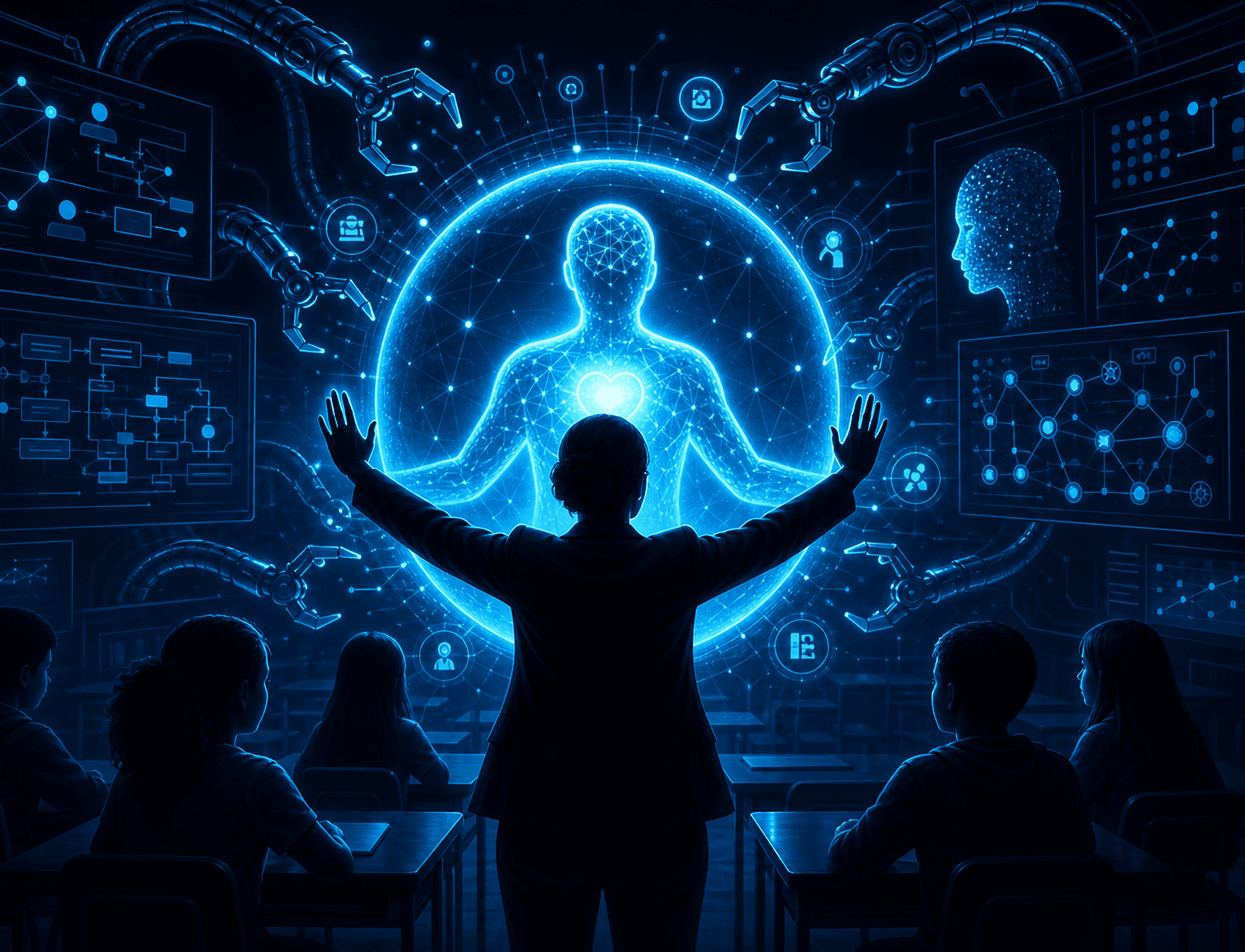
At its best, education changes lives through relationship. Remove that, and schools may become efficient but spiritually empty.
The Future of AI in Education Must Stay Human
AI in education is powerful. It can improve productivity, expand access, and help schools operate with greater intelligence.
But schools must be careful not to confuse automation with wisdom.
Because the most important outcomes in education are not always the easiest to measure.
Not every lesson is about information.
Not every problem is academic.
Not every student needs a faster answer.
Sometimes they need a wiser adult.
The schools that lead well in the coming years will not be the ones that automate everything. They will be the ones that know what must remain human, protect it intentionally, and use AI to strengthen education rather than empty it of its soul.
Conclusion
AI should absolutely have a place in education. But it should serve the mission of education, not redefine it without reflection.
Schools must decide, with clarity and courage, what should never be automated.
Because in the end, the future of education is not only about smarter systems.
It is about whether we still value the human beings at the center of learning.
CTA
Explore more articles on AI, education, and modern learning at trananhvu.com