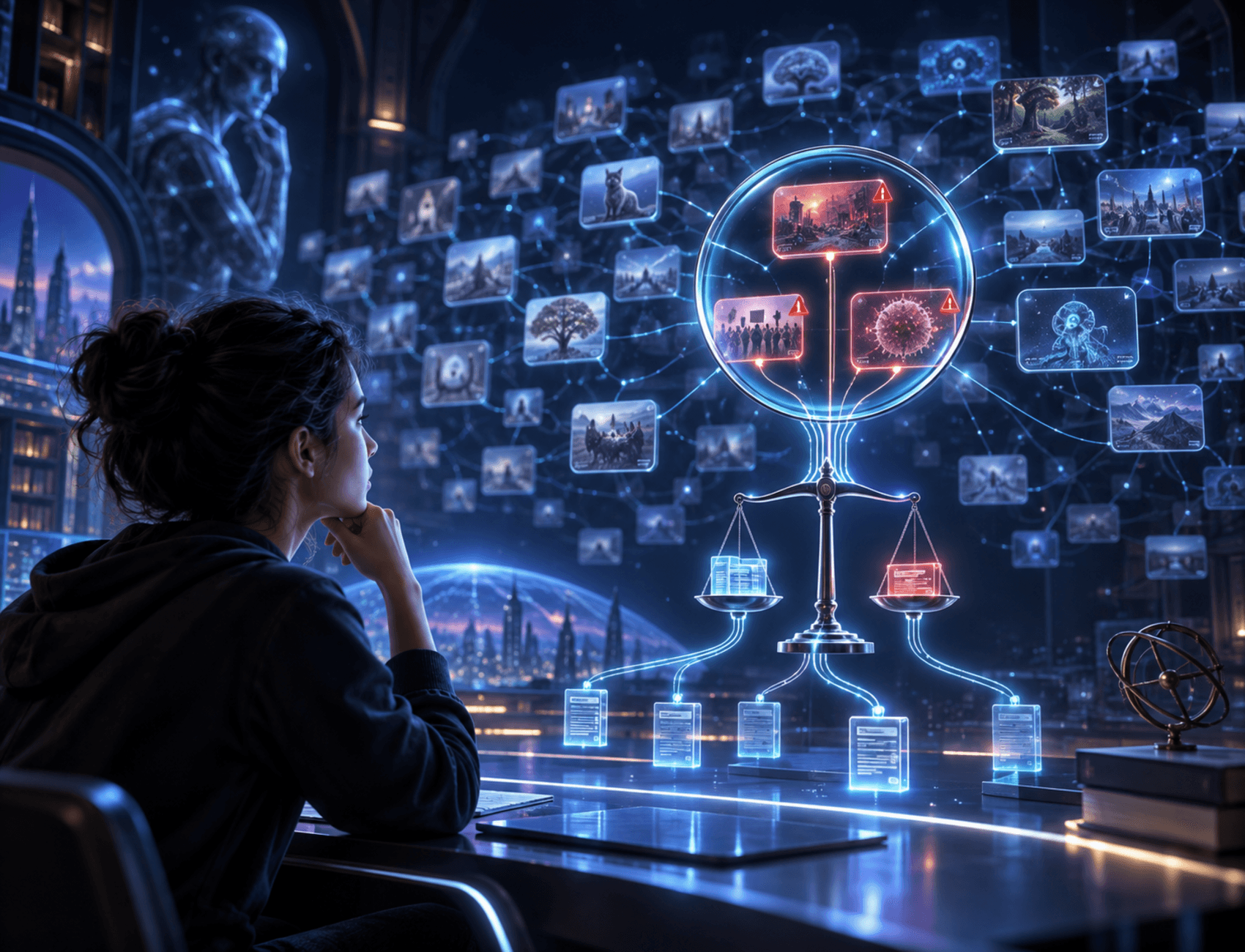
Telling students to “check the sources” is no longer enough.
The advice is correct, but incomplete. AI can produce dozens of claims, examples, citations, calculations, and recommendations in seconds. Verifying every element with equal rigor can take far longer than generating it. In real learning and professional work, time and attention are limited.
The deeper capability is not universal skepticism. It is verification economics: deciding what deserves verification, how much evidence is enough, and where the cost of being wrong justifies greater effort.
The Verification Burden Has Shifted
Before generative AI, producing a detailed answer usually required substantial effort. The act of writing, calculating, searching, and synthesizing created natural friction. That friction did not guarantee accuracy, but it limited the volume of claims a person could produce.
AI reverses the ratio. Generation becomes cheap; evaluation remains costly.
A learner can request a literature review, business analysis, lesson plan, or code solution almost instantly. The output may contain fifty statements with different levels of importance and uncertainty. If the learner treats them all as equally trustworthy, error spreads. If the learner verifies every sentence, the productivity advantage disappears.
Education therefore faces an allocation problem: how should limited verification effort be distributed?
Source Checking Is One Step, Not the Whole Method
Source checking often focuses on whether a citation exists and whether it appears credible. That is necessary, but several other questions matter:
- Does the source actually support the claim?
- Is the claim current enough for this decision?
- Was the evidence produced in a comparable context?
- Has the AI transformed a cautious finding into a strong conclusion?
- Would a different interpretation materially change the answer?
- What happens if the claim is wrong?
A real source can be used inaccurately. A current source can be irrelevant. Multiple citations can repeat the same underlying evidence. Verification must examine the relationship between claim, evidence, context, and consequence.
Four Variables Determine Verification Effort
Students need a practical way to decide when deeper checking is required. Four variables provide a useful foundation.
1. Consequence
How serious is the outcome if the claim is wrong?
A minor wording suggestion does not deserve the same scrutiny as medical guidance, a financial calculation, a legal interpretation, a research conclusion, or an assessment decision. Verification effort should rise with potential harm.
2. Uncertainty
How likely is the claim to be wrong, incomplete, outdated, or context-dependent?
Novel topics, precise statistics, niche facts, causal claims, and rapidly changing information deserve more skepticism than stable definitions or low-stakes brainstorming material.
3. Reversibility
Can the decision be corrected easily after action?
A draft can be revised. A public accusation, submitted thesis, signed contract, or harmful intervention may be difficult to reverse. Low reversibility increases the required evidence threshold.
4. Verification cost
How much time, expertise, access, and attention are required to check the claim?
Some facts can be confirmed in an authoritative database within minutes. Others require specialist knowledge, original data, or replication. Learners should recognize the difference and choose an appropriate response: verify directly, seek expert review, reduce the strength of the claim, or avoid relying on it.
A Verification Portfolio, Not a Binary Choice
Verification is often taught as a binary action: checked or unchecked. In practice, it is a portfolio of methods with different costs and strengths.
Fast plausibility check
Ask whether the claim is internally coherent, mathematically possible, and consistent with known constraints. This catches obvious errors but does not establish truth.
Source trace
Locate the original or authoritative source and confirm that it supports the specific claim. Avoid relying only on summaries that cite one another.
Independent corroboration
Check whether separate credible sources reach compatible conclusions. Independence matters more than raw citation count.
Method inspection
Examine how the evidence was produced: sample, measurement, assumptions, comparison, and limitations. This is essential for research and causal claims.
Expert or stakeholder review
When context is specialized or consequences are high, involve someone with the authority or experience to judge what the evidence cannot reveal alone.
Real-world test
For reversible decisions, a bounded experiment may be more efficient than extended desk verification. The test still needs criteria, limits, and observation.
The mature learner selects among these methods instead of treating every claim as a research project.
A Classroom Framework: RISK
Educators can teach a simple four-part routine before students use AI-generated material in consequential work.
R — Rank the claims
Separate central claims from supporting details. Identify which claims would collapse the argument if they were false.
I — Inspect the risk
Assess consequence, uncertainty, and reversibility. High-risk claims receive more attention.
S — Select the verification method
Choose the least costly method capable of producing sufficient confidence: plausibility check, source trace, corroboration, method review, expert input, or experiment.
K — Keep an evidence record
Document what was checked, what remains uncertain, and how the uncertainty affects the conclusion. This makes judgment visible and reviewable.
The purpose is not to reward students for collecting the most sources. It is to assess whether they allocated attention intelligently.
Assessment Must Reward Verification Judgment
If assignments grade only the final output, students are encouraged to optimize fluency and appearance. Verification remains invisible.
Assessment can instead ask students to submit:
- a claim-risk map;
- the two or three highest-risk claims;
- the verification method chosen for each;
- evidence that changed or narrowed the conclusion;
- remaining uncertainty;
- a short explanation of why further checking was or was not justified.
This reveals intellectual maturity more clearly than a generic statement that “sources were checked.” It also discourages performative citation, where references are added for appearance rather than used for reasoning.
The Strategic Implication
AI literacy is often framed as the ability to generate better outputs. But abundant generation increases the value of selective attention.
Future-ready learners will not be those who distrust everything or accept everything. They will know where uncertainty matters, where evidence is affordable, when a quick test is enough, and when a decision must stop until stronger verification is available.
That capability transfers beyond the classroom. It supports better research, management, marketing, policy, and professional judgment.
Conclusion
Source checking asks whether evidence exists. Verification economics asks how much confidence the decision requires and what it is worth spending to obtain it.
Education must teach students to manage that trade-off explicitly. When AI makes claims cheap, judgment depends on allocating verification effort where error would matter most.
The goal is not perfect certainty. It is responsible confidence.
Key Takeaways
- Generative AI makes production cheap while evaluation remains costly.
- Verification effort should reflect consequence, uncertainty, reversibility, and checking cost.
- Different claims require different methods, from plausibility checks to expert review.
- Students should rank claims and verify those most important to the decision.
- Assessment should make verification choices and remaining uncertainty visible.
FAQ
What is verification economics in education?
Verification economics is the disciplined allocation of limited time and attention to checking claims according to their risk, uncertainty, reversibility, and verification cost.
Should students verify every AI-generated claim?
No. They should identify which claims are central and consequential, then apply a level of verification proportionate to the risk of error.
How can teachers assess verification skills?
Teachers can require claim-risk maps, evidence traces, explanations of chosen verification methods, and disclosure of remaining uncertainty.