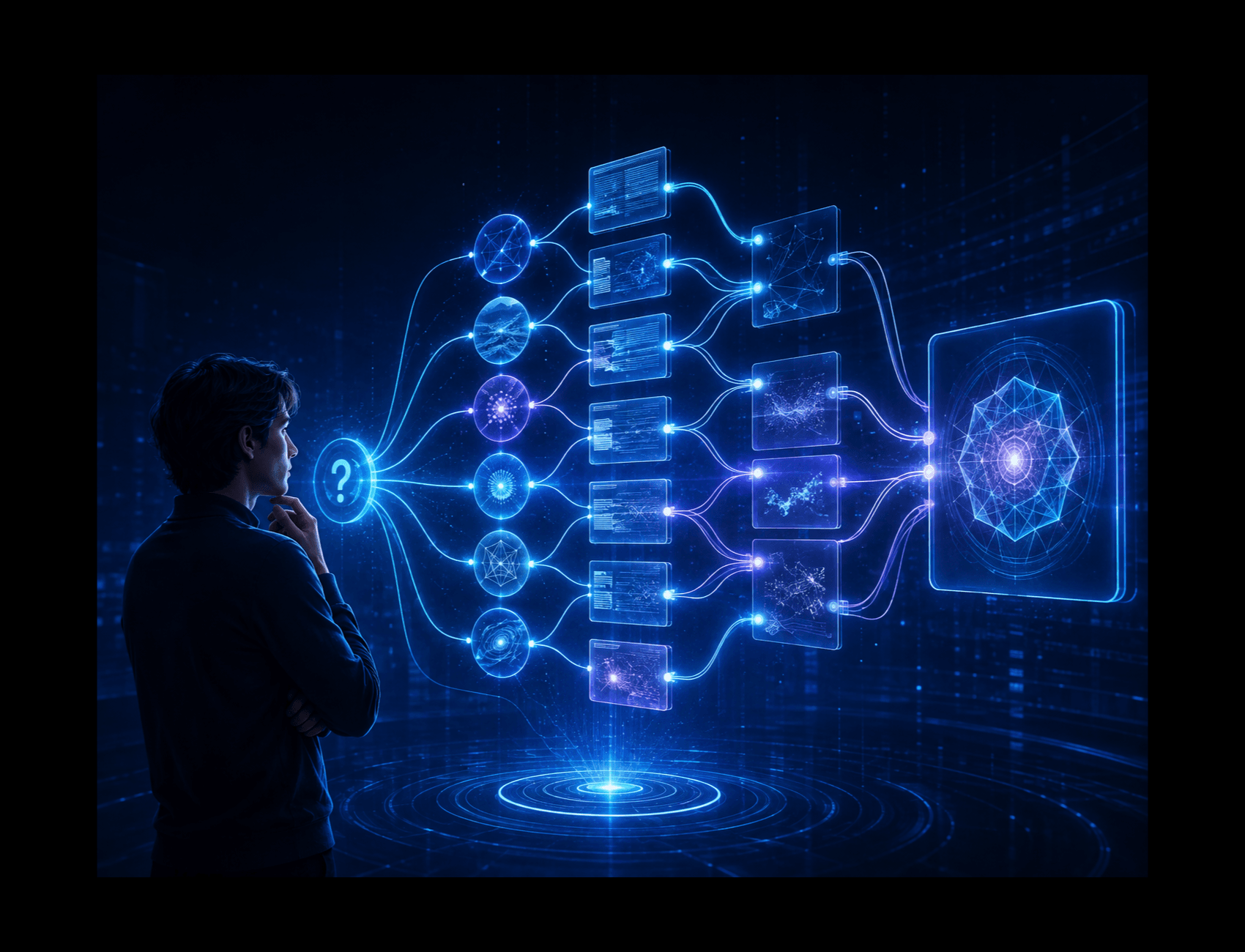
Critical thinking has become the standard answer to almost every concern about AI in education.
Students should question outputs, detect bias, verify claims, and avoid accepting fluent answers at face value. All of this is correct. But it remains incomplete.
Criticism is not the same as construction.
A learner may recognize that an AI answer is weak and still be unable to build a stronger one. They may sense that a claim lacks evidence but not know what proof is needed, how sources should be compared, or how a conclusion should change when new information appears.
AI-era education must therefore teach evidence construction: the ability to build an auditable path from question to claim, source, interpretation, conclusion, and revision.
Skepticism Alone Does Not Produce Knowledge
Students are often told not to trust AI. This can create caution, but caution without method easily becomes vague suspicion.
The learner says, “This might be wrong,” then performs a quick search, finds a page that appears to agree, and considers the task complete. The output has been checked, but the reasoning has not been rebuilt.
Evidence construction asks harder questions:
- What exactly is the claim?
- What kind of proof could support it?
- Who produced that source material, and for what purpose?
- Does the source establish correlation, causation, interpretation, or only opinion?
- What findings point in another direction?
- How confident should the conclusion be?
These questions turn verification from a ritual into an intellectual process.
Fluent Answers Hide the Structure of Knowing
Generative AI compresses the visible work between a question and an answer.
That convenience is useful, but it can obscure how knowledge is produced. The learner sees a polished conclusion without seeing the decisions that shaped it: source selection, definition, exclusion, inference, uncertainty, and interpretation.
When the process disappears, students may judge quality through fluency. A coherent paragraph feels more credible than a fragmented set of notes, even when the notes contain stronger support.
Education must make the hidden structure visible again.
The objective is not to force students to reject AI assistance. It is to ensure that assistance does not replace their understanding of how a defensible conclusion is built.
The Evidence Chain
A practical model for AI-era learning has six parts.
1. Question
The student defines what is actually being investigated.
A broad topic is not yet a research question. The question should identify the object, context, relationship, and boundary of inquiry. Better questions reduce irrelevant evidence and expose which terms require definition.
2. Claim
The learner states the proposition that needs support.
AI-generated writing often blends several claims into one paragraph. Separating them is essential because different claims may require different forms of evidence.
3. Source
The learner selects evidence according to its fitness for the claim.
Authority alone is not enough. A credible source can still be outdated, indirect, poorly matched to the context, or unable to support the conclusion being drawn.
4. Interpretation
Evidence does not explain itself.
Students must show how the source supports the claim, what assumptions connect them, and where alternative interpretations remain possible. This is where human judgment becomes visible.
5. Conclusion
The conclusion should be proportional to the evidence.
Weak evidence should produce a tentative conclusion. Strong converging evidence may justify greater confidence. Intellectual maturity includes the ability to say not only what one believes, but how strongly and why.
6. Revision
New evidence should be able to change the conclusion.
Revision is not a sign of failure. It is evidence that the learner treats knowledge as accountable to reality rather than to the first answer produced.
AI Can Support the Chain Without Owning It
AI can contribute at every stage. It can help narrow a question, decompose claims, suggest source types, identify counterarguments, compare interpretations, or test whether a conclusion overreaches.
But the student must retain ownership of the chain.
That means being able to explain:
- why the question was framed this way;
- why these sources were selected;
- which evidence was rejected;
- where AI influenced the interpretation;
- what uncertainty remains;
- what would change the conclusion.
Disclosure tells us that AI was used. Evidence construction tells us whether the resulting knowledge deserves trust.
Assessment Must Evaluate the Reasoning Artifact
If schools assess only the final essay, they reward presentation more than knowledge construction.
AI-era assessment should include artifacts that reveal the evidence process. Depending on the discipline, these may include:
- a claim-evidence map;
- an annotated source set;
- a log of rejected or revised claims;
- a comparison of conflicting evidence;
- confidence ratings with justification;
- an oral defense of the reasoning chain;
- a short reflection on how AI changed the inquiry.
These artifacts do not need to create excessive administrative work. A compact evidence map may reveal more learning than several pages of polished prose.
The principle is simple: assess the structure that produced the answer, not only the answer itself.
Teachers Need to Model Evidence Construction
Students cannot learn this practice from warnings alone.
Teachers need to demonstrate how experts move from uncertainty to a defensible position. That includes showing incomplete searches, ambiguous findings, changes of mind, and the limits of available evidence.
This may feel less efficient than presenting a finished explanation. But it teaches something more durable: how disciplined judgment works when the answer is not already known.
In an environment of abundant generated content, that process becomes a core educational capability.
Related Reading
Conclusion
Critical thinking remains essential, but it should not end with doubt.
Learners need the capability to construct something better than the answer they question. They must be able to assemble evidence, make interpretation visible, calibrate conclusions, and revise when reality demands it.
AI can accelerate this work. It should not make the work intellectually ownerless.
The future of education depends not only on whether students can detect weak answers, but on whether they can build trustworthy knowledge.
Key Takeaways
- Critical thinking without a construction method can become vague skepticism.
- Students need an auditable chain from question to evidence, interpretation, and conclusion.
- AI may support each stage, but learners must retain intellectual ownership.
- Assessment should evaluate reasoning artifacts, not only polished final output.
FAQ
What is evidence construction?
It is the disciplined process of connecting a question to claims, appropriate sources, interpretation, proportional conclusions, and revision.
How is it different from fact-checking?
Fact-checking tests whether a statement is accurate. Evidence construction reveals how a complete conclusion was built and how strongly it is supported.
Can students use AI during this process?
Yes. AI can assist with inquiry and critique, but students should be able to explain and defend the reasoning chain themselves.


