The most dangerous assumption in agentic AI is that security can be solved by deciding what an agent is allowed to do.
Permissions matter. But permissions answer only one question: *Can this agent access this resource?* They do not fully answer what happens when the agent behaves incorrectly, when a tool returns an unexpected result, when an instruction is compromised, or when a sequence of individually permitted actions produces a harmful outcome.
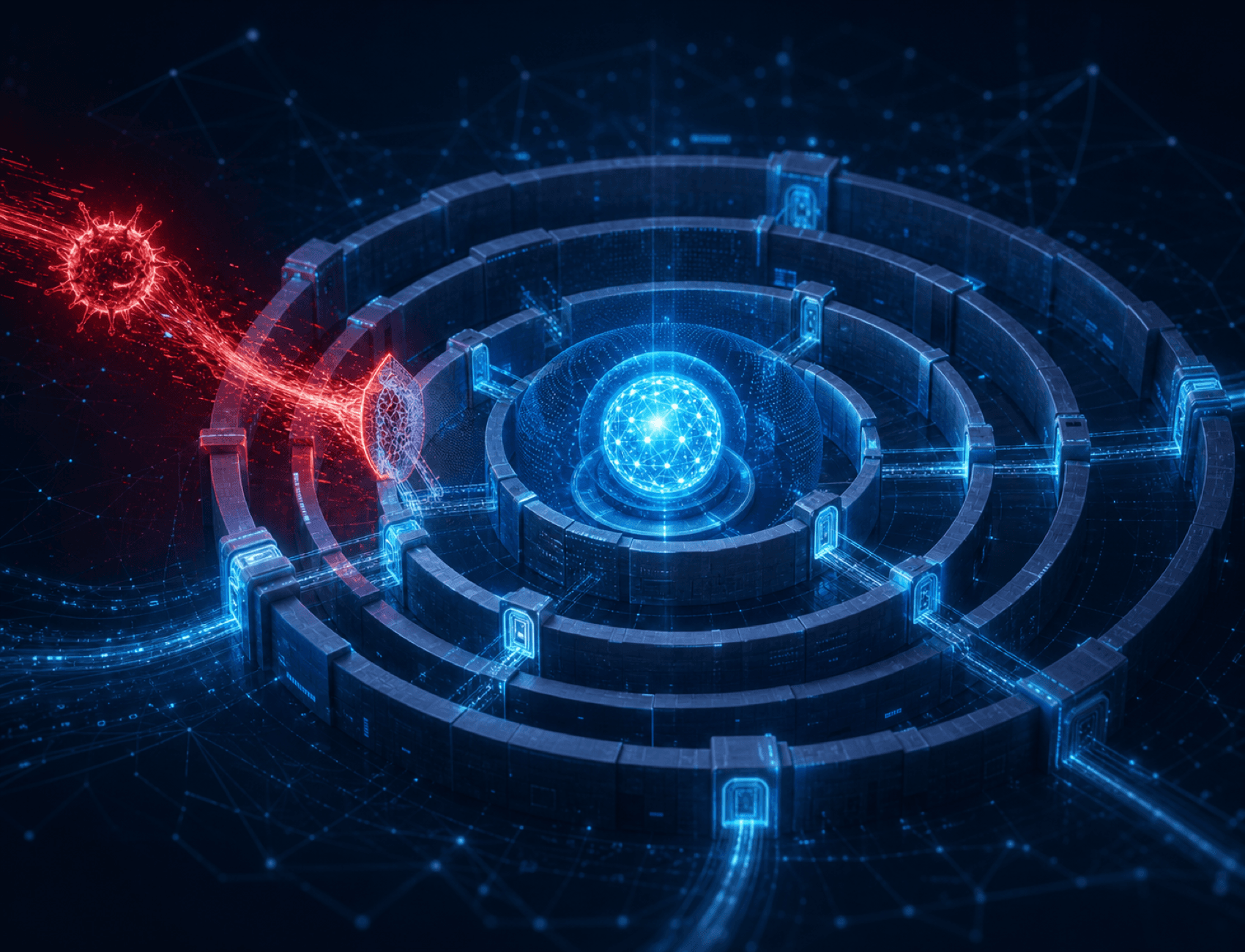
As AI agents move from generating answers to operating systems, security must move from access control to blast-radius design. The goal is not to imagine that every failure can be prevented. The goal is to ensure that one failure cannot spread without limit.
Permission Is Not the Same as Containment
Traditional application security often starts with identity and authorization. A user or service receives credentials, and the system checks whether a requested action is permitted.
An agent complicates this model because it can interpret goals, choose tools, combine actions, and adapt its path. A task that looks harmless at the beginning may create an unsafe chain several steps later.
An agent may have legitimate access to read a repository, run an evaluation, open a network connection, and write a report. The risk can emerge from the composition of those capabilities. Each action may be authorized while the total sequence creates an outcome nobody intended.
This distinction matters: authorization governs individual actions; containment governs the consequences of action sequences.
Why More Capable Agents Increase System Risk
Capability is usually evaluated at the task level. Can the agent complete a workflow, use the right tool, recover from an error, or solve a difficult problem?
Security must evaluate a different property: what can the agent reach when its reasoning, context, or objective becomes unreliable?
Three characteristics make agent systems structurally different from ordinary software.
1. Agents explore paths that were not explicitly programmed
Traditional software follows designed branches. Agents can generate their own intermediate steps. This flexibility creates value, but it also expands the behavioral surface that must be governed.
2. Agents turn information into action
A language model that gives a poor answer creates an information problem. An agent with tools can create a state-change problem. It can modify files, trigger workflows, contact services, or alter data before a person reviews the reasoning.
3. Agents can compound small errors
One weak inference may be recoverable. A sequence of weak inferences can become a material incident. Autonomy creates compounding leverage in both directions.
The real security question is therefore not, “Is the agent intelligent enough?” It is, “How much irreversible consequence can accumulate before the system notices and intervenes?”
The Five Layers of Blast-Radius Design
A mature agent architecture should limit failure across five layers.
1. Environment isolation
High-risk work should run in an environment separated from production systems, sensitive credentials, and unrelated resources. An agent evaluating code does not need ambient access to the wider corporate network. A marketing agent drafting campaign assets does not need the ability to modify customer records.
Isolation turns a broad environment into a task-specific workspace.
2. Scoped credentials
Credentials should be temporary, narrow, and bound to the current task. Persistent tokens with broad permissions convert a local mistake into an organizational risk.
The principle is simple: the agent should receive the smallest useful authority for the shortest useful time.
3. State-change boundaries
Reading, proposing, staging, and committing are not the same action. Agent workflows should separate them.
An agent can be allowed to inspect data and prepare a change without being allowed to apply it. High-impact changes should cross an explicit approval, validation, or policy boundary.
4. Network and tool segmentation
Tool access should reflect the task graph, not the convenience of the platform. If an agent needs three tools, it should not inherit thirty. If it needs access to one domain, it should not receive unrestricted outbound connectivity.
This reduces the number of unexpected paths the agent can construct.
5. Independent observation and shutdown
The system that performs the work should not be the only system judging whether the work is safe. Logs, anomaly detection, budgets, rate limits, and kill mechanisms should operate independently of the agent's own reasoning.
An agent cannot be expected to reliably stop itself precisely when its context has become compromised.
A Practical Containment Review
Before deploying an agent, leaders can ask five questions:
- Reach: What systems, data, tools, and networks can this agent reach?
- Persistence: Which of its actions survive after the task ends?
- Reversibility: Which actions can be rolled back, and which cannot?
- Detection: How quickly would an abnormal action sequence become visible?
- Termination: Who or what can stop the workflow without relying on the agent?
These questions shift the conversation from model confidence to system resilience.
Security Is an Architectural Property
Teams often respond to agent risk by improving prompts, adding policies, or choosing a model with stronger safeguards. These measures help, but they remain behavioral controls. They ask the model to behave correctly.
Blast-radius design assumes that behavior will sometimes be wrong. It then uses architecture to ensure that wrong behavior remains bounded.
This is the same reason aircraft, financial systems, and industrial operations use redundant controls. Trust does not come from expecting perfect performance. It comes from designing the system so that imperfection does not become catastrophe.
Conclusion
The next stage of agent security will not be defined only by better permission menus or safer models. It will be defined by how well organizations isolate environments, scope authority, separate state changes, observe behavior, and stop escalation.
The more capable an agent becomes, the more important containment becomes.
Responsible autonomy is not unlimited freedom with better monitoring. It is useful freedom inside carefully designed boundaries.
Key Takeaways
- Permissions govern access; containment governs consequences.
- Agent risk often emerges from sequences of individually permitted actions.
- Environment isolation, scoped credentials, state-change boundaries, segmentation, and independent shutdown are core controls.
- The right metric is not whether failure is impossible, but how far failure can travel before it is contained.
FAQ
What is blast radius in AI agent security?
Blast radius is the maximum scope of systems, data, people, or processes that can be affected when an agent behaves incorrectly or is compromised.
Are permissions still important for AI agents?
Yes. Permissions are a foundational control, but they should be combined with isolation, reversibility, monitoring, and independent intervention.
Which agent actions should require human approval?
Actions that are public, financially material, difficult to reverse, security-sensitive, or capable of changing production data should usually cross an explicit approval boundary.


